A payment is not finished when a blockchain explorer displays a successful transaction. It is finished when the recipient has the agreed amount, in a form they can actually use.
That distinction changes how a cross-border stablecoin payment should be priced. Sending a token between wallets can be inexpensive while buying it, converting it and paying out to a bank account costs considerably more. The reverse can also happen: if both parties already use the same stablecoin and network, the route may avoid conversions that a bank-to-bank payment requires.
The useful comparison begins with two endpoints: what leaves the sender’s account and what becomes available to the recipient. Everything between them belongs in the calculation.
Define the payment before comparing prices
“The cost of sending $10,000” is an incomplete question. Is the sender spending exactly $10,000, with fees deducted from the recipient’s proceeds? Or must the recipient receive exactly $10,000, with charges paid on top?
The answers produce different funding amounts. They can also produce different rankings between providers when minimum fees, percentage charges or exchange-rate spreads apply.
The currencies matter just as much. A dollar stablecoin can carry value between two countries without solving the conversion from the sender’s local currency into dollars, or from dollars into the recipient’s local currency. If both conversions are necessary, both belong in the quote.
Write the requirement as a complete instruction: the sender funds from a specified account and currency; the recipient receives a specified net amount in a specified account and currency; the money must be available by a specified time. A wallet-to-wallet transfer is a valid endpoint when that is what the recipient wants. A bank deposit is a different service.
This is also why an advertised blockchain fee cannot stand in for a remittance price. The World Bank’s Remittance Prices Worldwide methodology includes both the transfer fee and the exchange-rate margin in its cost comparisons. It also warns about incomplete information and destination charges that may not be captured. Source: World Bank methodology.
Follow the money through the full route
A typical fiat-to-fiat route can contain several operations. The sender funds a service provider, receives or purchases stablecoins, transfers them, and uses another provider to convert and pay out. One company may package the operations together; that does not make the underlying work disappear.
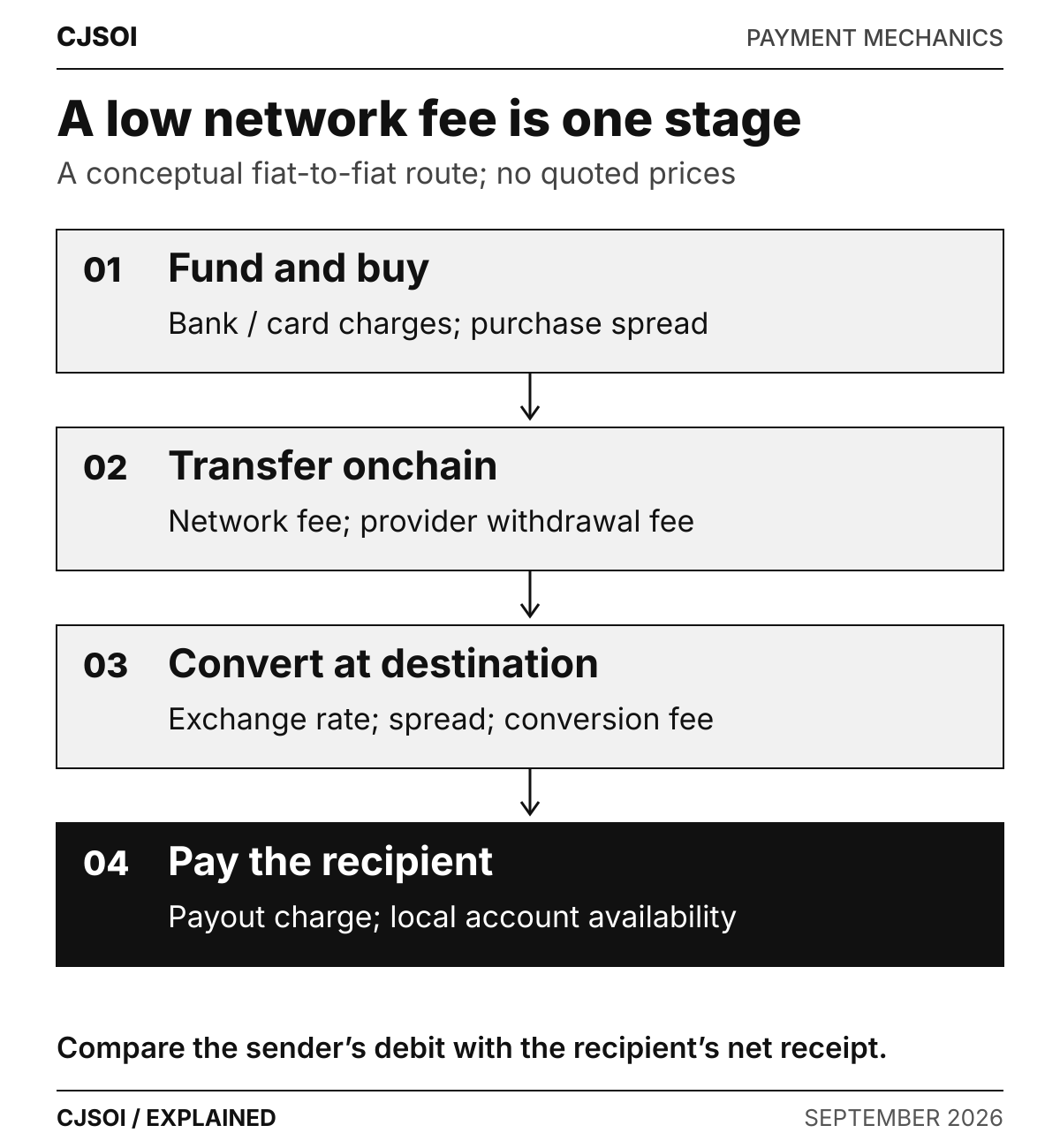
Figure 1. A conceptual fiat-to-fiat payment route. Some providers combine stages; wallet-to-wallet payments may omit the conversions and bank payout. The sequence describes possible cost locations, not a quote. Select the image for full size.
At the funding stage, ask whether money arrives by bank transfer, card or an existing account balance. The method can change both the charge and the time before funds become usable.
For the onchain leg, distinguish the blockchain’s transaction charge from a platform withdrawal charge. A provider may charge a fixed amount that differs from the network fee. The token and network must also match what the destination accepts.
At the receiving end, conversion can include an explicit fee, a spread in the exchange rate, or both. The final bank or cash payout may add another fee or impose a minimum. A platform quoting “zero transfer fee” can still have an exchange-rate margin.
A quote that combines these costs is often easier to use than a long fee schedule, provided it identifies the final amount and how long the quote remains valid. The question is whether a charge is included, excluded, or still unknown.
A worked $10,000 payment, with every assumption visible
The following example is hypothetical. It is designed to show how deductions accumulate, not to represent a provider, country or current market price.
Assume the sender starts with $10,000. All stages are expressed in dollar-equivalent terms, and the conversion charge includes the assumed exchange-rate cost. The funding fee is 0.20% of the starting amount. The network charge is $1. The conversion deduction is 0.35% of the balance arriving at that stage. The payout charge is $5.
| Stage | Calculation | Balance after the stage |
|---|---|---|
| Starting funds | Sender spends $10,000 | $10,000.00 |
| Funding | Deduct 0.20% × $10,000 = $20 | $9,980.00 |
| Network transfer | Deduct $1 | $9,979.00 |
| Conversion | Deduct 0.35% × $9,979 = $34.9265 | $9,944.07 |
| Recipient payout | Deduct $5 | $9,939.07 |
The total reduction is approximately $60.93, or 0.6093% of the starting amount. Calculations retain full precision until the displayed rounding. Real providers may apply their own rounding at each stage.
If the recipient must receive exactly $10,000 under these same assumptions, adding $60.93 to the original transfer is not quite sufficient. The larger starting amount also creates larger percentage-based deductions.
Let the required starting amount be G. The net amount is:
Net received = ((G × 0.998) − $1) × 0.9965 − $5.
Solving for a $10,000 net receipt and rounding the required starting funds up to the next cent gives $10,061.27. The example is useful because it makes the fee bases explicit. A provider that calculates both percentage fees on the original principal will produce a slightly different answer.
The same route also looks different at a smaller size. With $200 of starting funds and the same hypothetical charges, the recipient would receive about $192.90: a reduction of approximately 3.55%. The fixed $6 of charges weighs much more heavily on a small payment. Neither result should be generalized beyond the assumptions.
What the World Bank data actually tells us
The World Bank’s Q3 2025 report put the global average remittance cost at 6.36%. Its digital-remittance average was 4.59%, compared with 7.30% for non-digital remittances.
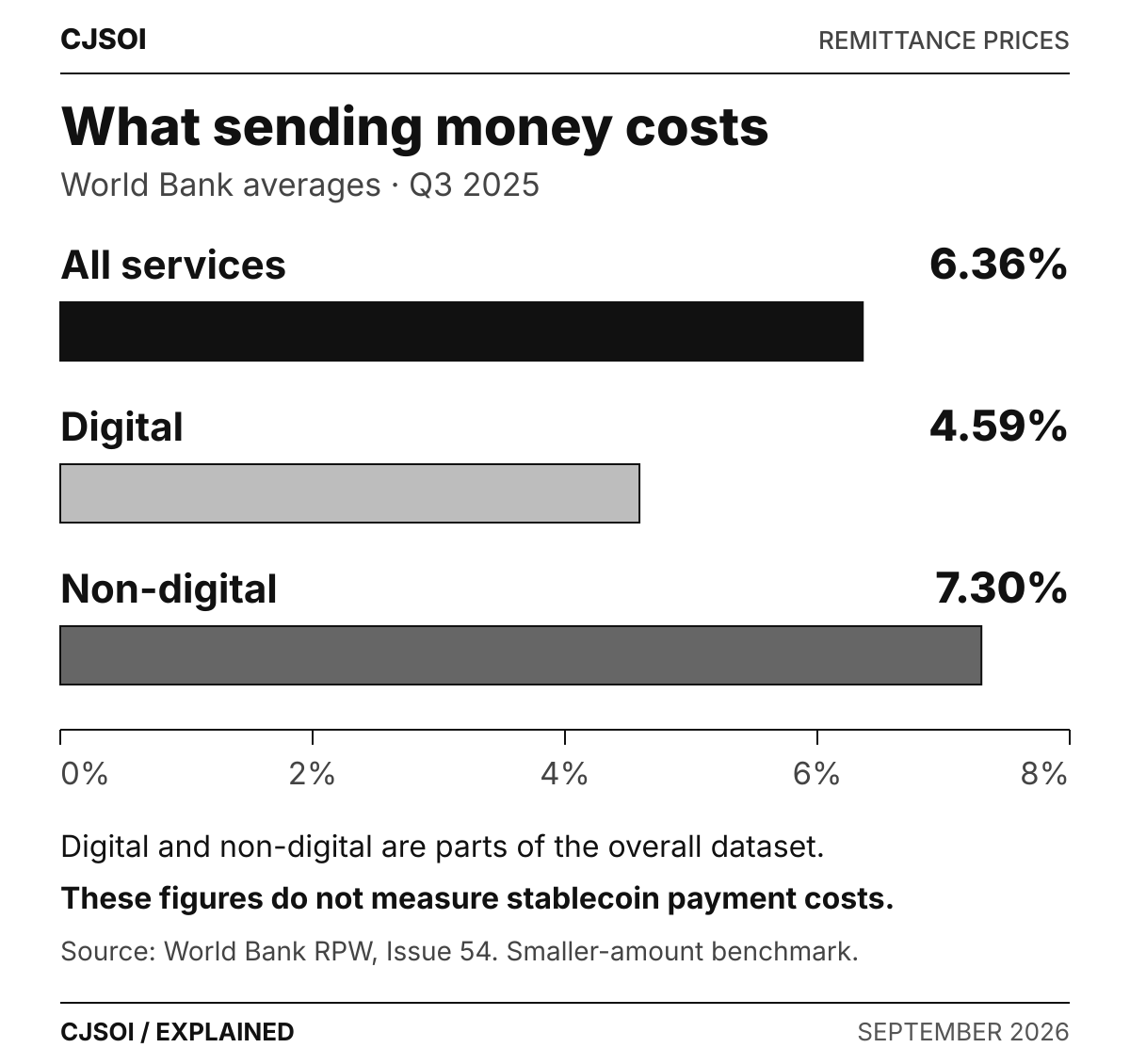
Figure 2. Reported average remittance costs in Q3 2025, as a percentage of the amount sent, for the report’s smaller-amount benchmark. Digital and non-digital services are categories within the overall dataset. These are not stablecoin cost estimates. Source: World Bank, Remittance Prices Worldwide, Issue 54. Select the chart for full size.
The three values are shown in text as well as in the chart: all services 6.36%; digital 4.59%; non-digital 7.30%. The report defines digital remittances through the sending and receiving methods, including self-assisted digital sending and receipt into an account. It does not use “digital” as a synonym for “stablecoin.”
The benchmark also needs context. The World Bank methodology uses standardized local-currency amounts associated with its $200 and $500 benchmarks; those local amounts were established historically. A current transaction should not be assumed to have exactly the same dollar amount or conditions as the survey observation.
These averages describe a market problem, but they are not a live quote for a particular corridor. The methodology describes price snapshots and notes limitations, including destination-side fees or taxes that may not be captured.
Most importantly, our hypothetical $10,000 payment at approximately 0.61% cannot establish a saving against a global retail remittance average of 6.36%. The amounts, corridors, services and evidence differ. A valid comparison needs competing quotes for the same actual payment.
Why direct redemption is not a universal shortcut
It is tempting to remove the receiving provider from the diagram and assume any holder can redeem directly with the issuer at negligible cost. Access conditions and minimums make that assumption unreliable.
Circle describes Circle Mint as an institutional service and says it is not available to individuals. Retail access to USDC through another provider does not automatically create a Circle Mint account. That means a retail user’s practical cash-out price may be the exchange or payment provider’s quote, even when the token has an issuer redemption mechanism. Source: Circle Mint eligibility.
Tether’s published fee schedule gives a different concrete example. It lists a $100,000 minimum for acquisitions and redemptions, with a redemption fee equal to the greater of $1,000 or 0.1%. The schedule also lists a separate verification charge. These are direct-issuer terms, not the fees of every exchange that supports USDT. Source: Tether fees, checked September 26, 2026.
For the redemption fee alone, the arithmetic is:
| Direct redemption amount | Fee under the published rule | Effective percentage |
|---|---|---|
| $100,000 | $1,000 | 1.00% |
| $1,000,000 | $1,000 | 0.10% |
| $10,000,000 | $10,000 | 0.10% |
This table excludes other applicable charges and does not establish account eligibility. It shows how a minimum fee changes the effective rate. A slogan about one-to-one redemption does not describe the full access and transaction cost for every holder. Our redemption explainer covers that distinction in more detail.
Price the exchange rate, not just the visible fee
When currencies differ, a useful comparison starts with a reference exchange rate recorded at the same time as the quote. Calculate what the recipient would receive at that reference rate, then compare the actual net receipt.
Suppose a hypothetical reference rate converts one unit of the sender’s currency into 1.10 units of the destination currency. A provider offers 1.08 with no separately stated transfer fee. On 1,000 units sent, the difference is 20 destination-currency units: 1,100 at the reference rate versus 1,080 at the quoted rate.
That difference is approximately 1.82% of the reference proceeds. It is a spread calculation, not proof that the reference rate was executable for this customer or transfer size. The rate source, time, quote duration and any additional fees still need to be recorded.
A stablecoin route can contain more than one exchange. Buying a dollar token with one currency and selling it for another creates two possible spreads. If a provider already quotes the final net payout, do not add estimated spreads on top and double-count costs that are included.
Speed, availability and failed payments belong in the review
A cheap route that misses a payroll or supplier deadline may not meet the payment requirement. Separate blockchain confirmation from the receiving provider’s crediting process and the final bank payout.
Circle’s own Mint page qualifies instant settlement by reference to participating banks and their supported programs. The presence of a continuously operating blockchain does not establish that every bank account at either end can be credited continuously. Source: Circle Mint settlement notes.
For a business payment, ask what happens if the destination rejects the transfer, requests more documentation or cannot complete the conversion. Who provides support? In which currency would a refund be made? Could a second conversion or return fee apply? Record the provider’s actual answer rather than assuming a blockchain transaction has a conventional card-style reversal.
There are also operational costs that may be significant but should not be invented as a percentage. Reconciliation, approvals, custody arrangements and staff time need to be assessed against the business’s existing workflow. Keeping a prefunded balance can improve availability while tying up money; that is a separate treasury choice.
A quote sheet that makes routes comparable
Before selecting a route, collect the following for each candidate:
- The sender’s total debit and the recipient’s guaranteed or estimated net receipt.
- Both currencies, the exact token, and the supported network.
- Every included charge, every excluded charge, and the basis for percentage fees.
- The exchange rate, quote expiry and treatment of price changes.
- The expected availability time at the recipient’s actual endpoint.
- Eligibility, limits, documentation and the procedure for a failed payout.
Compare that complete instruction with a conventional bank or payment-provider quote for the same amount and deadline. If the recipient will retain stablecoins, compare wallet delivery with wallet delivery. If the recipient needs bank money, price the cash-out in both alternatives.
For recurring supplier payments, our supplier-payments guide discusses the operational setup. Choosing a network covers the separate problem of getting the asset to a supported destination.
Common questions
Is a low network fee evidence of a cheap international payment?
It is evidence about one stage. Funding, currency conversion and payout can dominate the total. Check the net amount received before drawing a conclusion.
Are stablecoins always cheaper for larger transfers?
No. Larger transfers can dilute fixed fees, but rates, liquidity, provider limits and payout terms still vary. The worked example demonstrates fee arithmetic, not a universal ranking.
Should the payment end in stablecoins or local currency?
That depends on the recipient’s actual requirement. A wallet balance is not equivalent to a local bank deposit if the recipient must convert it before paying expenses. Agree on the endpoint before agreeing on the price.
Method note: expanded September 26, 2026. The World Bank figures describe Q3 2025 observations. Provider terms were checked for this revision and may change. Numerical payment and exchange-rate examples are hypothetical and are not provider quotations.