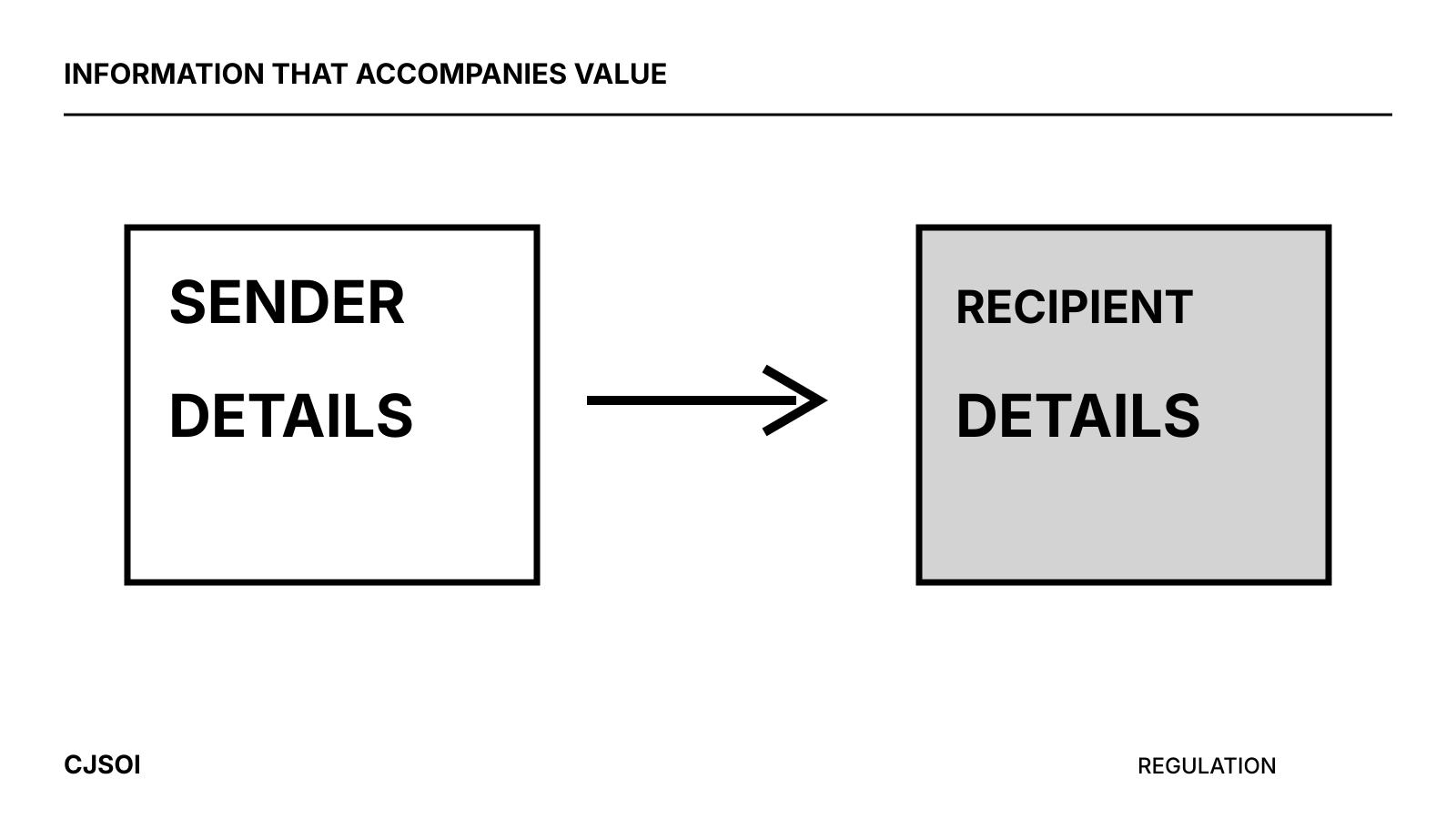
The crypto Travel Rule concerns information about a transfer’s originator and beneficiary that relevant service providers must obtain, retain and transmit under applicable requirements. It is separate from the movement of the crypto asset itself.
A blockchain address can identify a destination on a network without supplying all the identity information a regulated provider needs. That is why an application may ask questions before releasing or crediting a transfer.
The standard concerns providers and information
The FATF’s virtual-assets overview describes requirements for virtual asset service providers to collect and securely transmit originator and beneficiary information. It places this alongside customer due diligence, record keeping and reporting obligations.
FATF develops international standards. Their application to a particular transfer depends on the relevant domestic rules, the parties and the services involved. A global standards document should not be treated as a single universal transaction form.
Specific data fields, thresholds and treatment of different counterparties need to be checked in the applicable jurisdiction. This article does not provide a country-by-country compliance checklist.
The data does not have to be a public memo
A transfer of tokens and an exchange of compliance information are different processes. The Travel Rule should not be interpreted as an instruction for a customer to publish personal identity details in a public blockchain transaction.
FATF emphasizes secure collection and transmission. A provider needs appropriate means to handle the information and connect it to the relevant transfer.
From a user’s perspective, the important distinction is between a legitimate provider’s authenticated request and an unsolicited demand for sensitive information. Required transfer information should not be confused with a request for a wallet seed phrase or signing secret.
Why an extra step can appear in a withdrawal
A provider may need to identify the receiving institution or obtain information about the beneficiary before completing its process. A technically valid blockchain destination does not necessarily satisfy those requirements.
The reverse is also true: providing identity information does not prove the asset was successfully delivered. The network record and the provider’s compliance record serve different purposes.
A transfer can therefore pass one stage and still wait at another. A blockchain confirmation does not override a provider’s legal or operational obligations.
Self-hosted wallets need a jurisdiction-specific answer
Transfers involving a wallet controlled by its user can raise different questions from transfers between two service providers. The exact treatment should be read in current local rules and the provider’s published process.
It is not sound to conclude that every wallet user becomes a regulated service provider merely by making a personal transfer. Nor is it sound to assume that using a self-hosted wallet removes all information requirements at the service-provider end.
Our smart-wallet guide explains control over signing and recovery. That technical question is distinct from the legal classification of an activity.
Questions
Does the Travel Rule require publishing my identity onchain?
It concerns secure handling and transmission of required information, not a blanket instruction to post personal data publicly.
Are the same thresholds used everywhere?
Do not assume so. Domestic implementation and the circumstances of the transfer matter.
Does compliance information replace the transaction record?
No. The identity-related process and the asset-transfer record answer different questions.
Sources
FATF virtual-assets standards overview, checked September 26, 2026. This is general explanatory reporting, not a determination of an individual transfer’s legal requirements.