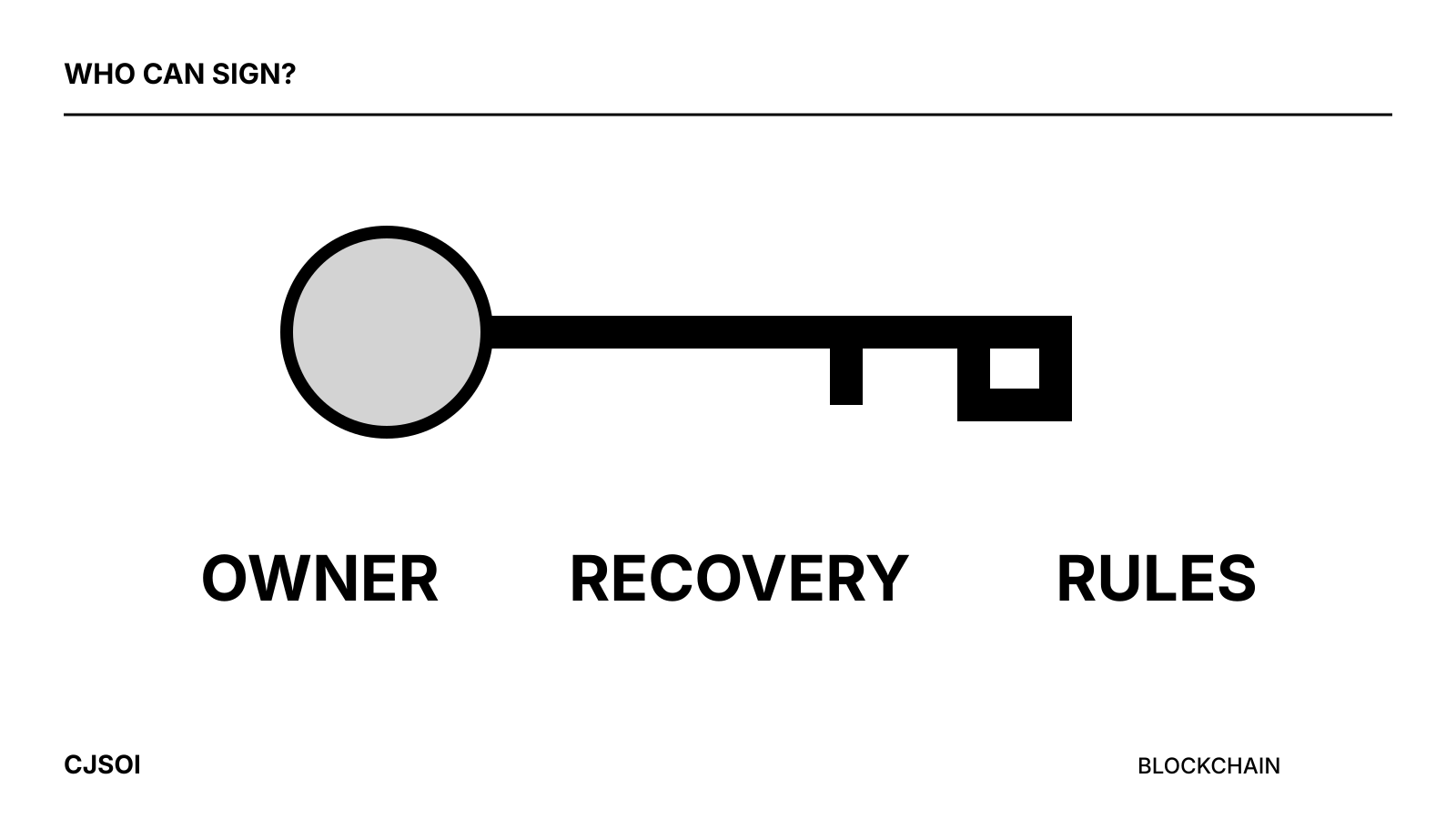
A smart wallet’s control is defined by the rules that authorize actions, recover access and change those rules. A convenient login screen does not tell you who can move the assets.
Smart accounts can make wallet behavior more flexible. That flexibility also means control has to be examined as a set of permissions rather than reduced to one question about a seed phrase.
The account decides what counts as authorization
In the ERC-4337 model, a smart account supplies validation logic for a user operation. The specification supports account designs with different signature methods, multiple signers and custom recovery.
A bundler packages operations for execution through the relevant infrastructure. A paymaster can agree to pay transaction costs. Those roles are distinct from the account’s own authorization rules.
This is a framework, not a promise that every wallet implements every feature. A product can use a smart account while making narrow choices about signing or recovery.
Recovery is a form of authority
Recovery arrangements answer what happens when the usual signer is lost or unavailable. Depending on the implementation, another signer, a set of guardians or a service may help restore access.
The relevant questions are who can initiate recovery, what approvals are required and whether the user receives a delay or opportunity to object. A recovery feature is useful only if its powers and failure modes are understood.
Ethereum’s account-abstraction overview discusses recovery and multi-key designs as possible capabilities. It should not be read as a guarantee about a wallet that happens to use the term “smart.”
Limited permissions can still move real money
A wallet may support spending limits, restricted destinations or delegated actions. These can be useful for repeated payments or software acting on a user’s behalf.
A hypothetical payment agent allowed to spend up to a fixed amount has less authority than an unrestricted signer—but it still has authority. The scope, expiry and revocation of the permission matter.
An interface should make the difference visible. Approving one transfer and granting an ongoing permission are not interchangeable actions.
Ask who can change the rules
An upgrade mechanism can change the account’s behavior. Its control should therefore be considered alongside ordinary transaction signing and recovery.
Read the implementation’s documentation: who authorizes upgrades, what modules can be added and what happens if the provider stops operating? The presence of a hardware signer does not answer every question about the contracts it authorizes.
Likewise, a paymaster covering fees does not automatically take custody of the assets. Funding execution and authorizing execution are separate roles.
For institutional arrangements, our bank-custody explainer looks at the service relationship around control and safekeeping.
Questions
Does a social login make a wallet custodial?
The login method alone is insufficient. Examine who can authorize transfers, recover access and change the account.
Does a paymaster control my assets?
Not by definition. Its role is to fund execution costs; other permissions depend on the actual implementation.
Are all smart wallets recoverable?
No. Recovery depends on the account design and the configuration actually enabled.
Sources
ERC-4337 specification; Ethereum account-abstraction overview.