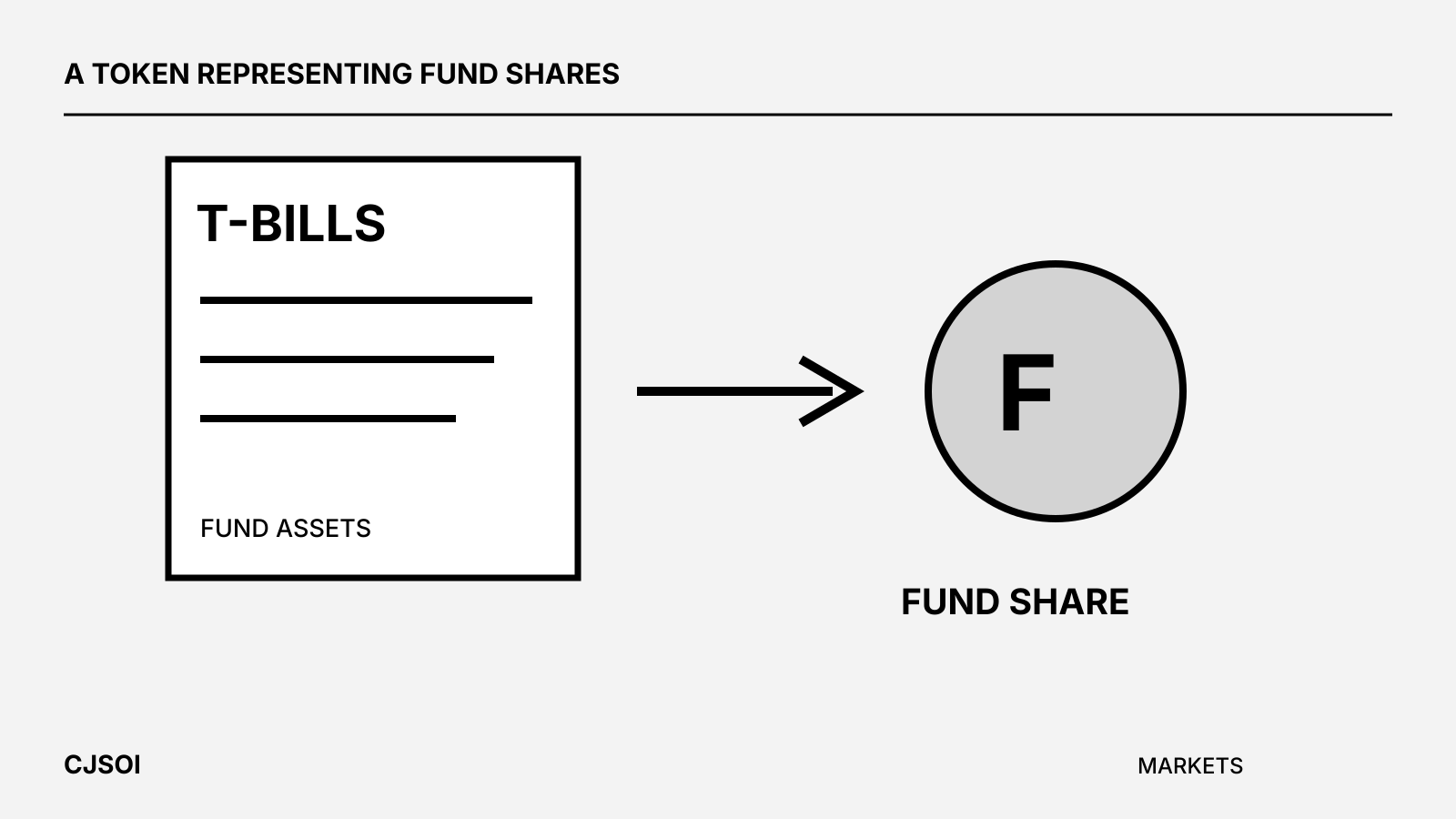
A tokenized Treasury fund can represent ownership of fund shares on a blockchain. The fund holds the underlying assets; the token holder’s rights arise from the fund and its documents. That is different from holding an individual Treasury bill directly.
It is also different from a payment stablecoin designed to track a fixed currency unit. A fund share can accrue income through its value rather than maintain a constant one-dollar token price.
The chain records the share, not the Treasury security
The Invesco USTB documentation describes shares in the Invesco Short Duration US Government Securities Fund. The fund invests in short-duration U.S. Treasury bills; shares can be held as tokens on supported networks or in book-entry form.
That distinction matters for ownership. The token is a representation of a fund share, while the fund has its own assets, administration and legal structure. A blockchain explorer is not a replacement for the offering documents.
Other tokenized products can use different structures. The term “tokenized Treasury” does not by itself identify whether the holder owns a fund share, a contractual claim or another instrument.
Income can appear in the share value
USTB’s documentation states that income is reflected in the net asset value per share rather than paid as distributions. The token quantity and the value per token are therefore separate numbers.
For illustration, holding 100 shares does not mean holding $100 if each share has a different net asset value. A transfer of those shares moves the share quantity; determining its monetary value requires the relevant valuation.
This example explains the units, not a return forecast. Tokenization does not fix future interest rates or eliminate investment and operational risks.
Transferability has conditions
The USTB documentation describes transfers between allowlisted wallet addresses. That is not unrestricted transferability to any address on a supported blockchain.
Eligibility, subscription and redemption terms must be read for the specific product. A token appearing in a wallet or application does not mean every person can purchase, receive or redeem it.
The same distinction applies to integrations with lending platforms. A token being usable as collateral in one arrangement does not erase the restrictions or risks of the underlying fund.
Redemption is an operational process
USTB supports subscriptions and redemptions through specified USD and USDC routes. Its documentation distinguishes bank-wire cut-offs from USDC processing, which is subject to available liquidity.
The underlying Treasury market and the token network do not have identical operating calendars. A network running all weekend does not make every fund asset continuously tradable or every bank payout immediate.
Before treating a tokenized fund as cash, examine the fund’s rights, eligibility, valuation, fees, liquidity and redemption conditions. For a different mechanism, see stablecoin redemption.
Questions
Do I hold a Treasury bill directly?
Not in the fund-share model described here. You hold a share with rights defined by the fund’s documents.
Must a tokenized fund token stay at one dollar?
No. Product design varies, and the share value can change as income accrues.
Can tokens always be transferred to anyone?
No. Allowlisting and investor restrictions may apply.
Sources
Invesco USTB product documentation, checked September 26, 2026; Circle Mint for the contrasting payment-token mechanism.