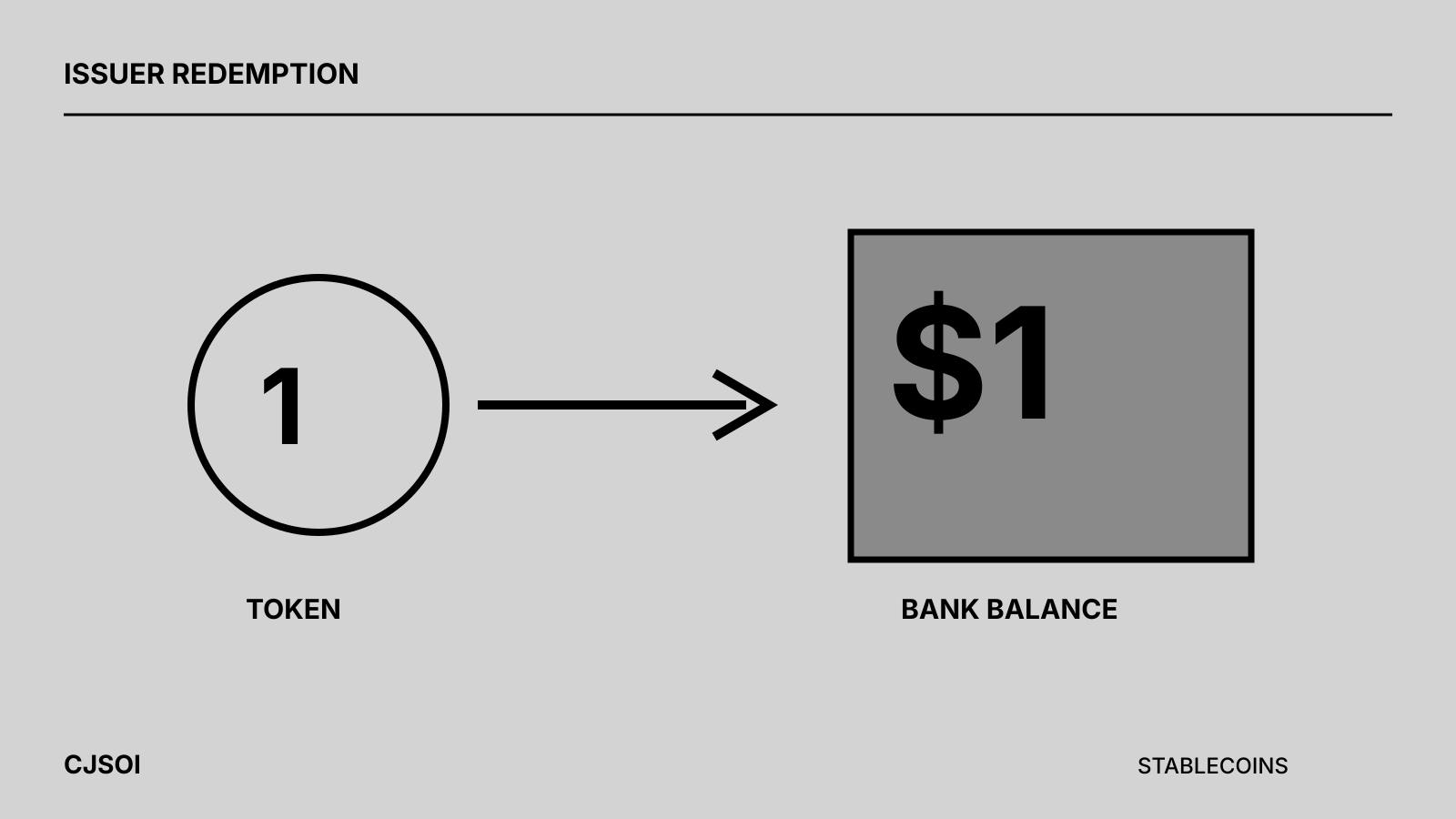
Stablecoin redemption is the process of returning tokens to an issuer in exchange for the underlying currency, subject to that issuer’s terms. Selling the same tokens on an exchange is different: another market participant buys them, and the issuer may never be involved.
That distinction matters when someone says a stablecoin can be exchanged for one dollar. It describes a redemption arrangement, not a guarantee that every wallet holder can send one token to the issuer and receive an immediate bank transfer.
Two ways to get back to dollars
An exchange sale matches a seller with available demand. Its price depends on the market, the order size and the trading venue. After selling, a user may still have to withdraw a fiat balance from that venue to a bank account.
Direct redemption follows the issuer’s process. The customer must qualify for an account, use a supported token and network, and provide the required payment instructions. The token balance is exchanged for fiat through that relationship. Circle’s Mint documentation, for example, describes an institutional service linking bank deposits, USDC or EURC issuance, transfers and redemption.
Imagine a business holding 50,000 USDC. Selling those tokens to a buyer transfers ownership; the tokens can remain in circulation. Redeeming through an eligible issuer account reduces the tokens outstanding through the issuer’s redemption process. The starting wallet balance may look identical, but the counterparties and records are different.
The token leg and the bank leg
A blockchain transfer confirms that an asset moved on a particular network. It does not prove that a bank has credited the recipient’s account. A redemption therefore has at least two distinct records to reconcile: the token movement and the fiat payment.
Supported networks matter. A token with a familiar name can be a bridged representation rather than an asset the issuer accepts directly. Read our explanation of native and bridged stablecoins before treating a ticker as sufficient identification.
Bank cut-off times, account checks, transfer instructions and provider processing can affect the fiat leg. A fast network cannot eliminate a delay outside that network. Nor does a successful transfer to an exchange mean the exchange has completed its own withdrawal checks.
Who can use the issuer’s window?
Access is not uniform. Circle Mint is aimed at institutional users. Tether publishes an acquisition and redemption minimum of $100,000 and a redemption charge of the greater of $1,000 or 0.1% on its fee page, checked on September 26, 2026. Those are issuer-service terms, not a universal minimum for trading USDT on exchanges. Fees and eligibility can change.
For smaller holders, the practical route may be an exchange or payment provider. That adds another counterparty and its own pricing, limits and withdrawal process. A redemption promise should therefore be read alongside the route the holder can actually access.
What the reserve tells you
Reserve disclosures help explain the assets supporting redemption. Circle describes cash, short-dated Treasury exposure and overnight Treasury repurchase agreements on its transparency page.
A reserve report and an individual redemption are different kinds of evidence. The report describes backing at a stated scope and date; the redemption record shows what happened to a particular customer’s request. Neither an exchange quote nor a transaction hash substitutes for both.
Questions
Is selling on an exchange the same as redeeming?
No. An exchange sale changes ownership at a market price. Issuer redemption uses the issuer’s process to exchange eligible tokens for fiat.
Does a one-dollar target eliminate fees?
No. Provider charges, trading spreads, withdrawal fees and bank costs can still affect what reaches the account.
Can any token called USDC be redeemed directly?
Do not assume so. Check the contract, network, native or bridged status, and the receiving provider’s supported assets.
Sources
Circle Mint documentation; Circle reserve disclosures; Tether fees. Product terms checked September 26, 2026.