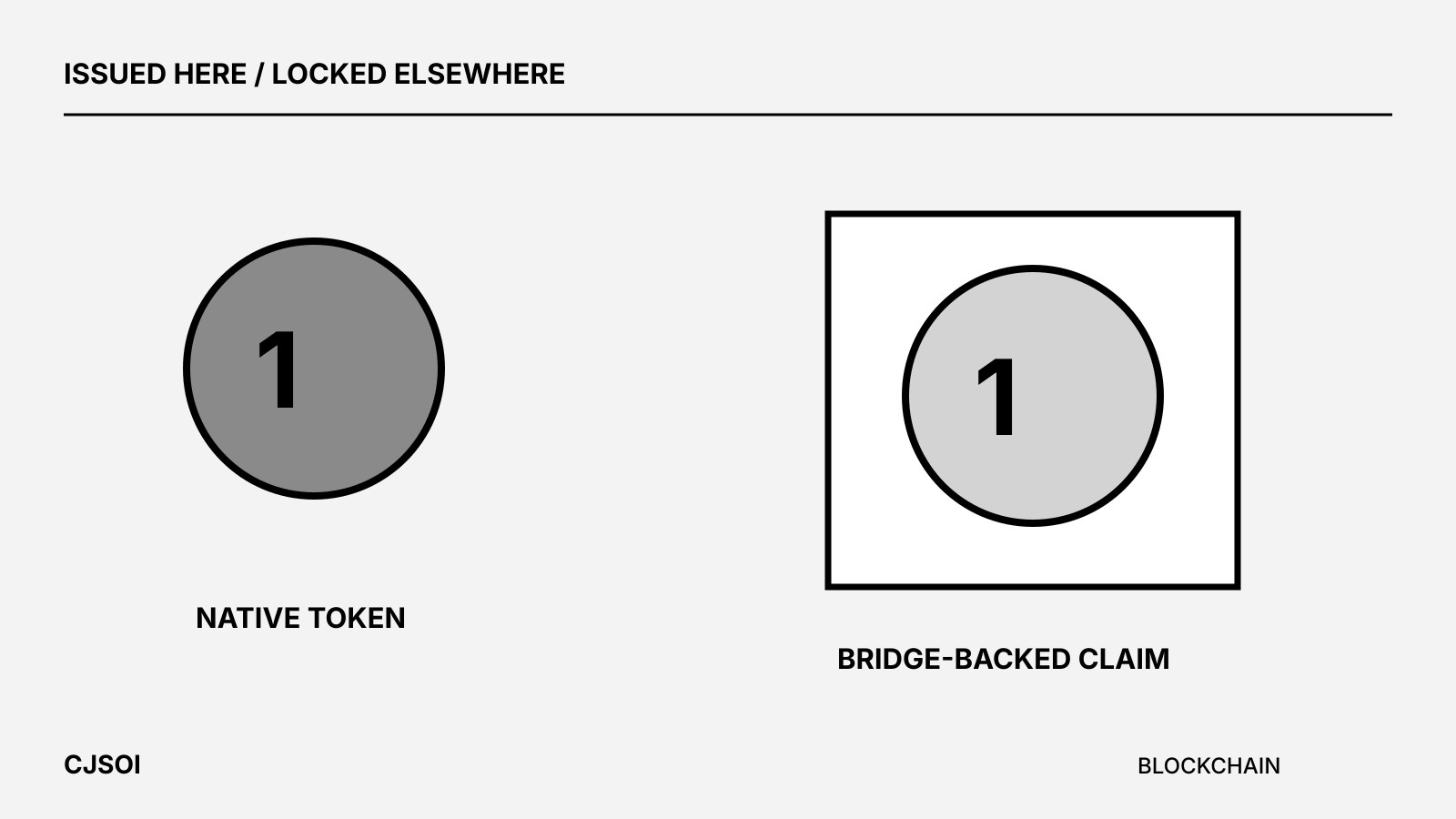
Two tokens can display the same dollar price and a similar name while giving their holders different routes back to money. One may have been issued directly by a stablecoin issuer on that blockchain. Another may represent tokens locked inside a bridge on a different network.
The distinction becomes important when making a deposit, redeeming a balance or trying to recover funds during an outage. A wallet symbol tells you what an asset is called; it does not establish who issued it, what backs it, or which service will accept it.
USDC provides a documented example of both arrangements. Circle distinguishes its native issuance from third-party bridged forms, and its Cross-Chain Transfer Protocol, or CCTP, shows how native tokens can move between supported networks through burning and minting. Understanding those mechanisms is more useful than treating every cross-chain transfer as the same operation.
Native describes the issuer, not the token’s popularity
A native stablecoin is issued directly on a particular blockchain by the stablecoin issuer. With native USDC, Circle’s issuance and redemption arrangements apply to that supported form of the token.
A bridged stablecoin is generally a representation created through a bridge mechanism. In a common lock-and-mint design, the original asset is held on one chain while a corresponding token is created on another. Circle explicitly says bridged forms of USDC are not issued by Circle. Source: Circle’s native and bridged USDC explanation.
“Native” does not mean that every holder has a direct account with the issuer. Circle Mint, for example, is an institutional service and is not available to individuals. A retail holder may use an exchange or another provider for cashing out native USDC. Source: Circle Mint eligibility.
There is also a terminology trap. A blockchain’s “native bridge” and an issuer’s “native stablecoin” describe different relationships. A bridge can be the established route into a network while the token it produces remains a bridged representation of an asset issued elsewhere.
Treat the asset’s identity as the combination of issuer or bridge, blockchain and token contract or asset identifier. A ticker alone is insufficient. This is particularly important when a destination lists several dollar-denominated tokens with similar labels.
Lock and mint: follow one hundred tokens
Consider an educational example with 100 native stablecoin units on Chain A. We assume a one-for-one mechanism and ignore fees so that the backing relationship is easy to see.
The holder transfers 100 native units into a bridge’s custody or contract on Chain A. After the bridge’s verification process accepts the deposit, the system creates 100 bridged units on Chain B. The holder can then use those destination-chain units.
The original 100 units have not vanished. They remain locked as backing. In a conventional return path, the holder gives up or burns the bridged units so that the corresponding originals can be released, subject to the bridge’s rules and operation.
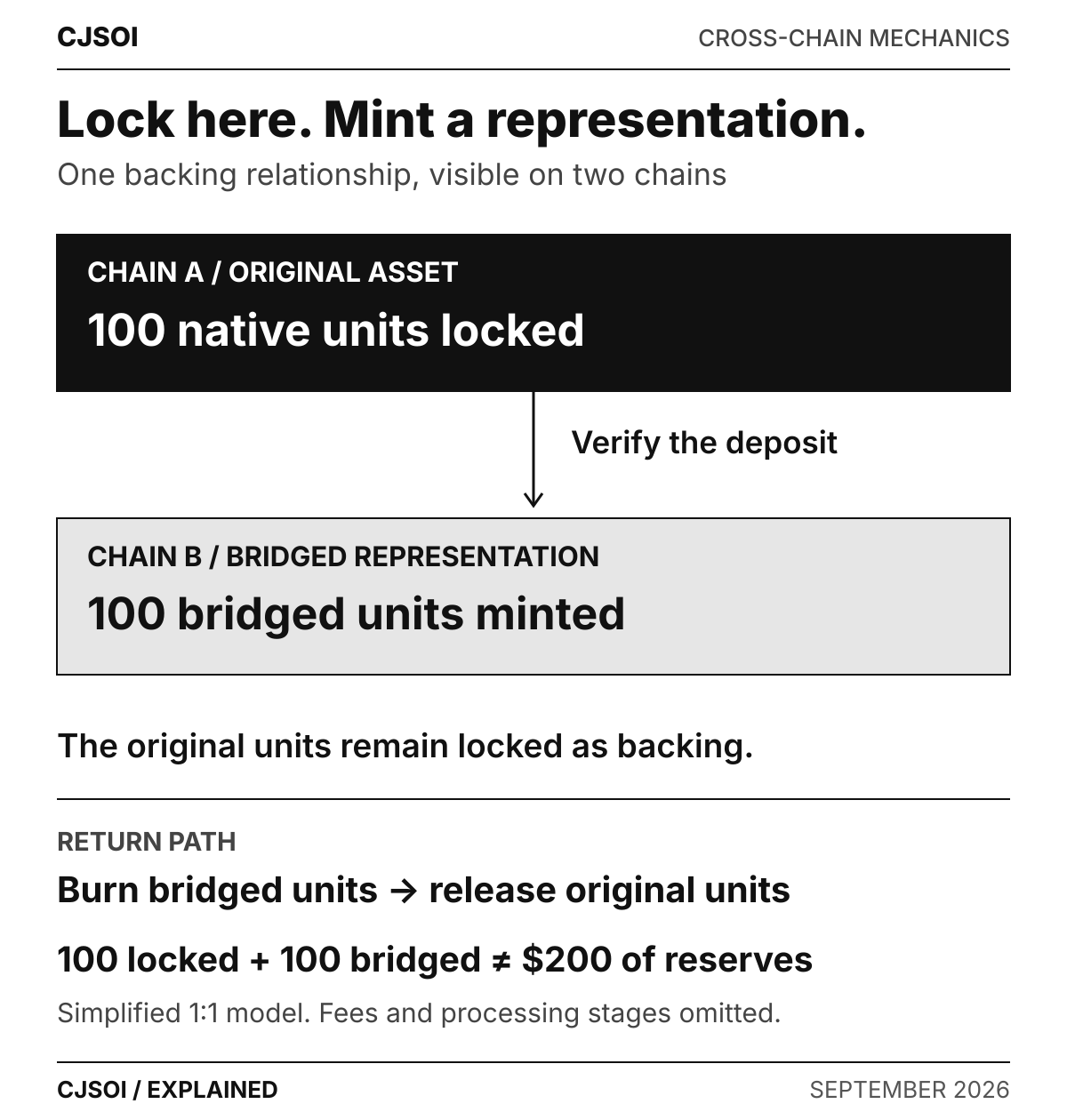
Figure 1. A simplified one-for-one lock-and-mint model. The 100 locked units and 100 bridged units are linked claims, not two independent pools of dollar reserves. Fees and intermediate processing are omitted. Based on the mechanism described by Ethereum.org and Circle. Select the diagram for full size.
This is where a common counting error appears. Adding the 100 units locked on Chain A to the 100 representations on Chain B and calling the result 200 independently dollar-backed units would double-count the same underlying backing relationship.
That does not mean every supply dashboard is wrong. A dashboard may deliberately show token contracts or balances on each network. The problem arises when the reader treats gross contract balances as an equivalent measure of independently issued money.
The holder on Chain B now depends on the original stablecoin and on the bridge mechanism linking their token to it. If that link fails, the fact that the original stablecoin remains backed does not automatically make the representation redeemable.
The extra dependency sits between the holder and the asset
A lock-and-mint bridge has to answer a consequential question: what evidence is sufficient to create tokens on the destination chain?
Different systems answer it differently. Some depend on external validators or signers. Others use mechanisms tied more closely to the connected chains’ verification systems. The design determines who or what can authorize a destination-side action.
Ethereum.org’s developer documentation describes bridge risks including contract flaws, counterparty behavior and uncertainty during network disruptions. These are categories to investigate, not a basis for assigning an invented numerical safety score. An audit is useful evidence about reviewed code; it does not remove all risks of an operating system. Source: Ethereum.org bridge documentation.
A reader can make the dependency concrete by asking:
- Where are the original tokens held, and can that balance be checked?
- Who can authorize minting, releases, upgrades or pauses?
- What prevents the same deposit from being used twice?
- What happens if the verification service or either blockchain stops progressing?
- Is there a documented return path, and who can help execute it?
The token’s current market price cannot answer these questions. A bridged asset can trade near one dollar because traders expect the mechanism to work. That price does not independently prove that the backing is accessible under every condition.
There is also a difference between backing and exit liquidity. A fully backed representation may still be difficult to sell promptly at the desired size. The bridge’s return mechanism and the market available to the holder are related but distinct ways of exiting.
Burn and mint: a different cross-chain arrangement
An issuer can support native issuance on more than one blockchain without moving tokens through a permanent pool of locked collateral.
Circle’s CCTP uses a burn-and-mint process. Tokens are destroyed on the source chain, Circle’s attestation service signs a message after the required confirmation conditions, and the destination-chain contracts verify that message before minting native USDC. The application or a relayer still has work to do between those stages. Source: CCTP technical guide.
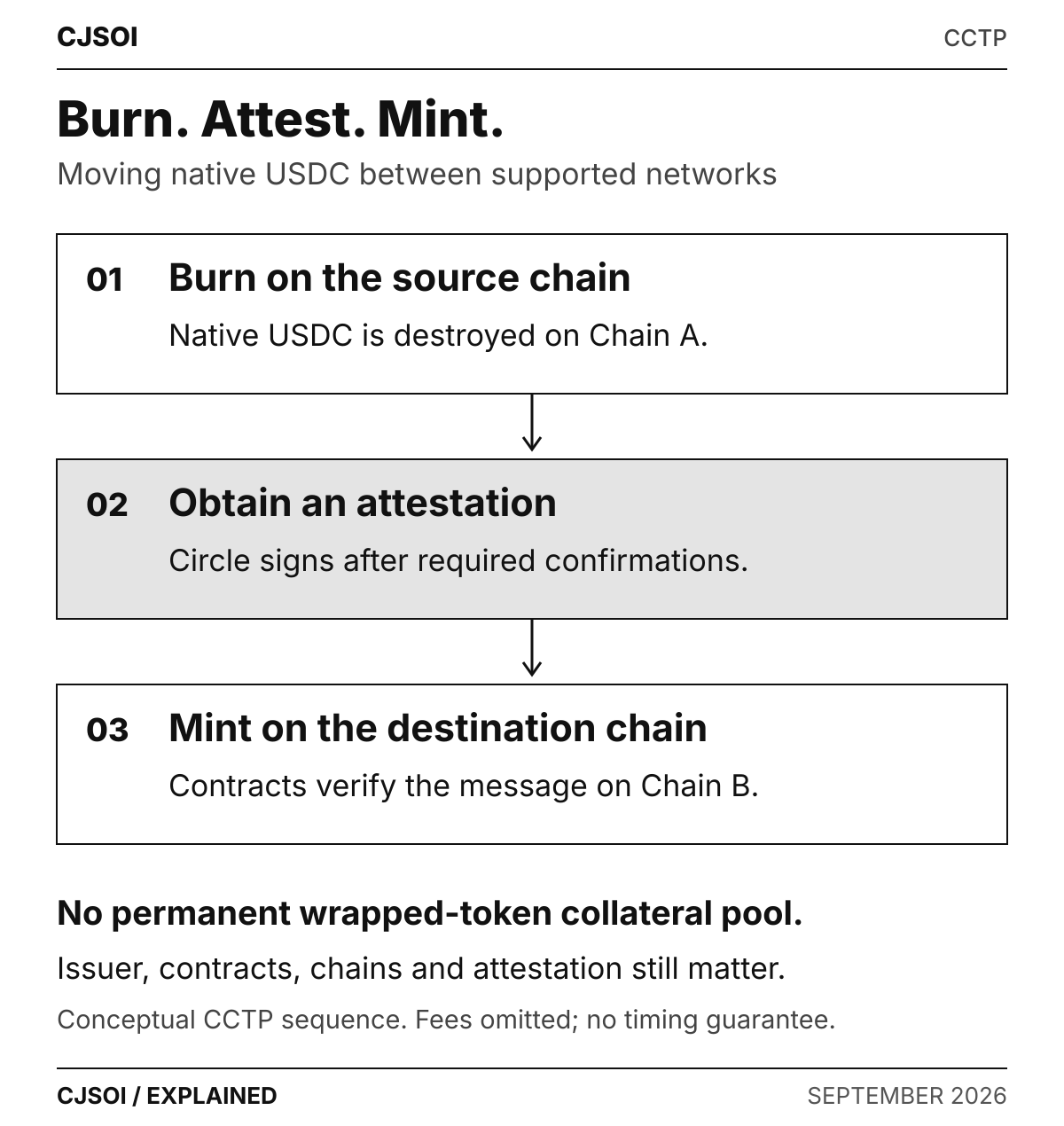
Figure 2. CCTP’s core burn, attest and mint sequence. This is a conceptual explanation, not a timing guarantee. Destination receipts can reflect applicable fees, which are omitted here. Source: Circle’s CCTP technical documentation. Select the diagram for full size.
In the simplified 100-unit example, the source-chain burn removes those units before the corresponding destination mint. The process does not leave a permanent set of 100 native tokens locked in a third-party bridge to back 100 wrapped tokens.
This removes that particular locked-collateral dependency. It does not remove the issuer, smart contracts, connected blockchains, attestation service or the application carrying out the transfer. Calling the route “native” is a description of the token and mechanism, not a guarantee that every surrounding component is failure-proof.
The attestation step also explains why a cross-chain transfer is not a single atomic action from the user’s perspective. A source transaction may be confirmed before the destination balance appears. A pending transfer needs to be investigated by stage, rather than treated immediately as either a completed payment or a permanent loss.
What the recipient can actually accept
A transfer is only useful if the destination accepts the exact asset produced by the route. An exchange that supports native USDC on a network may not support every bridged dollar token on that same network.
The same problem appears in decentralized applications. A lending market or liquidity pool integrates particular token contracts. A different asset with an almost identical name does not become compatible merely because its price is similar.
Before sending, use the destination’s own deposit instructions and the issuer’s or bridge’s official documentation to verify the network and asset identifier. Wallet search results and token icons are not substitutes for those records. A small test can help reveal an operational mismatch, although it cannot establish the long-term safety of a bridge.
If conversion is needed, include it in the plan before sending. A swap can introduce fees, slippage and an additional contract interaction. A bridge aggregator may combine several operations behind one interface, so the displayed route should be read through to the final asset.
Our guide to choosing a stablecoin network covers destination compatibility. The full payment-cost guide explains why a cheap bridge or network fee can still lead to an expensive end-to-end payment.
A comparison that avoids a false safety ranking
The distinctions can be summarized without pretending every implementation within a category is identical.
| Question | Native token on its current chain | Lock-and-mint representation | Native token moved through CCTP |
|---|---|---|---|
| Who issues the token held at the endpoint? | The stablecoin issuer | The bridge mechanism or its operator | Circle, for supported native USDC |
| Is a separate locked original needed to back that representation? | Not by virtue of being native | Yes, in this model | No permanent wrapped-token backing pool in this model |
| What additional transfer process matters? | The local transfer and any provider used | Locking, verification, minting and return release | Source burn, attestation and destination mint |
| Is direct issuer access automatic for a retail holder? | No | No | No |
| Is destination support still necessary? | Yes | Yes | Yes |
This table compares mechanisms, not brands or investment quality. A specific route may add an exchange, custodian, swap or relayer that is not shown in the simplified category. Its documentation and current operational state need separate review.
For a company managing payments, the relevant choice may also depend on reconciliation. Can the provider identify the original funding transaction, cross-chain message and final receipt as one business payment? A technically successful bridge transaction is not a complete accounting record for an invoice.
Does a bridged token eventually become native?
Sometimes a migration is possible, but it must be documented for that exact token.
Circle’s Bridged USDC Standard describes a deployment approach that can support a later upgrade to native USDC. Its documentation is explicit that Circle has the option, not the obligation, to perform such an upgrade. There is no automatic promise based on how popular a token becomes. The standard must also be incorporated when the bridged contract is deployed; Circle says it cannot simply be applied retroactively to an arbitrary existing contract. Source: Bridged USDC Standard and its limitations.
That matters when evaluating a claim that a token is “pre-native.” Readers should distinguish a technically supported migration path from a confirmed issuer decision, and both from a completed migration.
For a holder, the practical questions are specific: has the upgrade happened, which contract does it cover, does the destination recognize the resulting token, and is any action required? Do not infer those answers from a network announcement about future plans.
A successful migration can change the backing and issuance relationship. Until it occurs, the current mechanism is the one that needs to be evaluated.
If a transfer appears stuck, identify the stage
For a lock-and-mint route, distinguish a deposit that has not yet been accepted from a verified deposit whose destination mint has not completed. The appropriate support process depends on the bridge.
For CCTP, distinguish the source burn, attestation availability and destination mint. Circle’s documentation describes confirmation thresholds and a process for obtaining and submitting attestations. It also documents re-attestation for certain expired Fast Transfer messages. Those are protocol-specific procedures, not a universal repair method for other bridges. Source: CCTP technical guide.
Keep transaction identifiers and the route details available. Do not initiate a second full payment merely because the first destination balance is delayed without first establishing the original transfer’s status. A duplicate can turn a support problem into an overpayment.
Never give a support contact a seed phrase or private key. A legitimate status investigation can work with public transaction identifiers and the provider’s normal account-support process.
Questions readers ask
Can two tokens with the same ticker have different risks?
Yes. The contract, network, issuer and bridge relationship determine the asset. A shared ticker or price does not make two contracts interchangeable.
Is native USDC risk-free?
No. Native issuance avoids a third-party wrapped-token backing arrangement, but users still depend on issuer arrangements, the blockchain, software and any provider they use. Review those dependencies individually.
Does CCTP work with every bridged version of USDC?
No. Circle’s Bridged USDC Standard documentation distinguishes bridged tokens from native USDC and says bridged USDC is not compatible with CCTP. Use the currently supported native assets and routes, rather than assuming the protocol recognizes any dollar token.
Revision note: expanded September 26, 2026. Diagrams explain mechanisms and omit fees where stated. Network support, contract deployments and service conditions can change; verify the exact asset and destination before transferring.