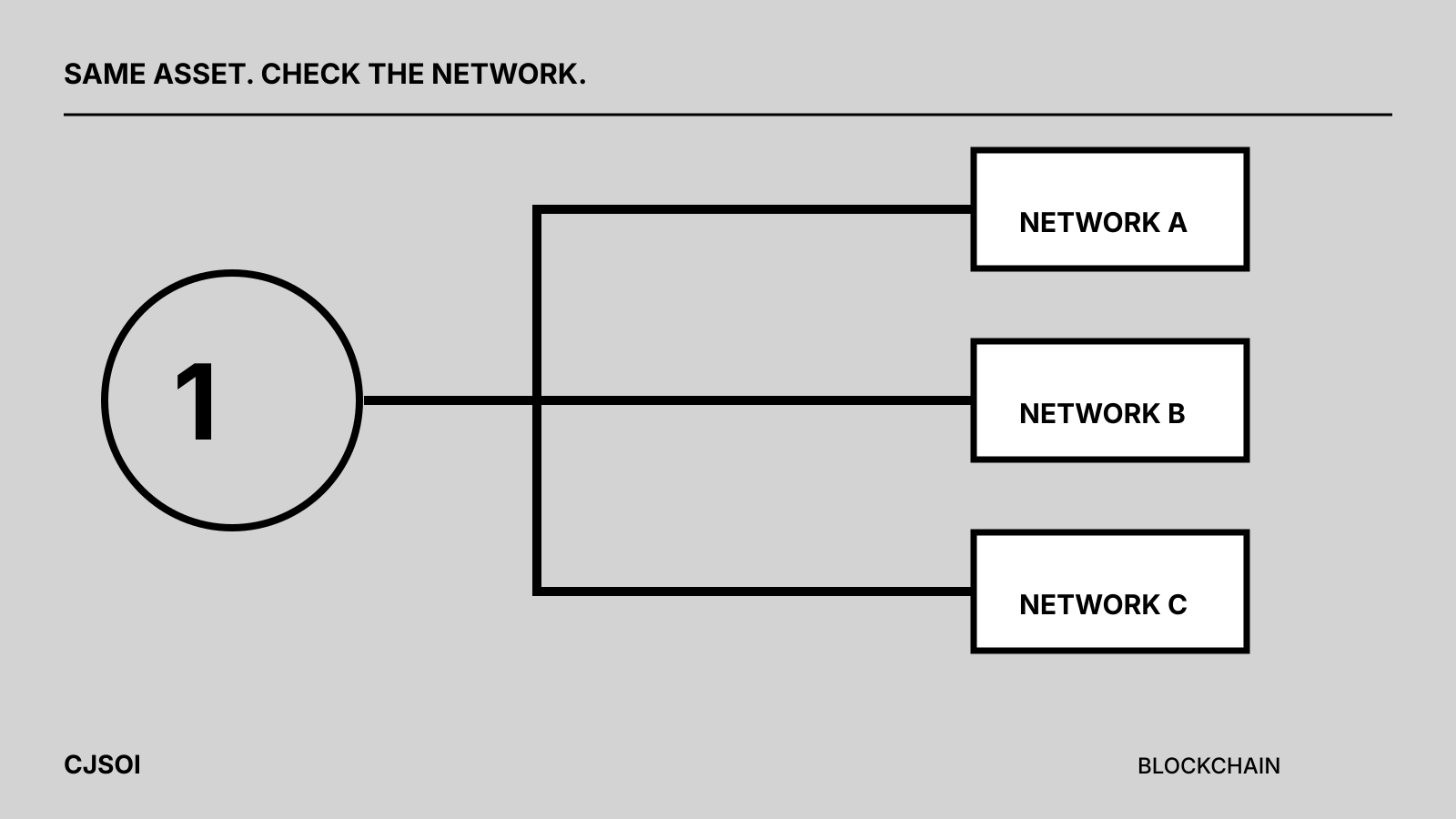
The right network for a stablecoin transfer is one that both the sender and the recipient support for the exact asset being moved. A cheap or fast network is not useful if the destination cannot credit the transfer.
Start with compatibility. Then examine the asset’s issuance model, the full cost and the confirmation rules used by the receiving service.
A ticker is not a complete payment instruction
The same asset name can appear on several blockchains. A receiving platform may support only some of them, or support one network for deposits and another for withdrawals.
Network selection should therefore begin with the destination’s current instructions. Check the chain, token contract where applicable and any additional reference the service requires. Do not assume that a wallet address which looks valid on several networks implies support on all of them.
This matters particularly for assets represented through bridges. Circle’s bridged-USDC documentation distinguishes a third-party bridged token from native USDC issued on a supported network.
Native support can simplify the route
If both sides already use the same native asset and network, a direct transfer can avoid an additional cross-chain step. If they use different networks, the route may require conversion, a bridge or another transfer mechanism.
Circle’s Cross-Chain Transfer Protocol uses a burn-and-mint mechanism for native USDC: the source-side tokens are burned and destination-side tokens are minted after the protocol’s verification process. That differs from locking tokens behind a traditional bridge representation.
It is still infrastructure with supported networks, contracts and operational dependencies. “Native” is not a synonym for risk-free.
Compare the time to a usable balance
A block being produced, a transaction becoming sufficiently final and a service crediting a deposit are different milestones. The receiving provider may wait for its own confirmation threshold or perform additional checks.
A quoted network speed may describe only one of those milestones. Cross-chain transfers can add another verification stage. CCTP, for example, distinguishes faster and standard transfer modes in its documentation.
For a business payment, the relevant time is usually when the recipient can use the agreed balance. If a bank payout follows, measure that leg too.
Count fees outside the transfer
The network charge may be only a small part of a route that includes buying the token, moving across networks or converting at the destination. Some wallets also need a separate asset for transaction fees unless an application handles that cost.
No permanent league table can identify the cheapest network for every payment. Charges, congestion, provider support and liquidity change. Obtain a current quote for the actual route and amount.
Our full payment-cost explainer shows how to compare like with like.
Questions
Should I choose the network with the lowest advertised fee?
Only after verifying that the recipient supports the exact asset on that network and that the complete route is suitable.
Is a cross-chain transfer the same as a normal transfer?
No. It connects separate networks and introduces additional mechanisms or providers.
Does a blockchain confirmation mean an exchange has credited me?
Not necessarily. The exchange applies its own deposit requirements.
Sources
Circle on bridged USDC; Circle CCTP documentation; Circle Mint documentation.