A stablecoin can circulate thousands of times without its issuer collecting a transaction fee. The business can still earn substantial income: the dollars backing the tokens may sit in interest-bearing reserve assets while customers use the tokens to move money.
That explains the attraction of issuing a dollar stablecoin. It does not tell us how much profit the issuer keeps. Distribution agreements, operating expenses and changes in interest rates can absorb much of the income.
Circle’s 2025 results provide a useful case study. The company reported $2.747 billion in total revenue and reserve income, but a $69.5 million net loss from continuing operations. Understanding how both figures can be true is a good way to understand the business. This guide uses the full-year 2024 and 2025 results, rather than treating one company’s quarterly performance as a universal industry margin. Source: Circle’s results filed with the SEC.
Start with the dollars behind the token
Consider a simplified issuer that receives $1 million from an eligible customer and issues one million dollar tokens. The customer has exchanged bank money for stablecoins. The issuer now needs reserve assets to support those tokens and their redemption.
The million dollars is not a million dollars of sales revenue. Treating the entire reserve as money the company can spend would confuse the backing of the stablecoin with the economics of running its issuer.
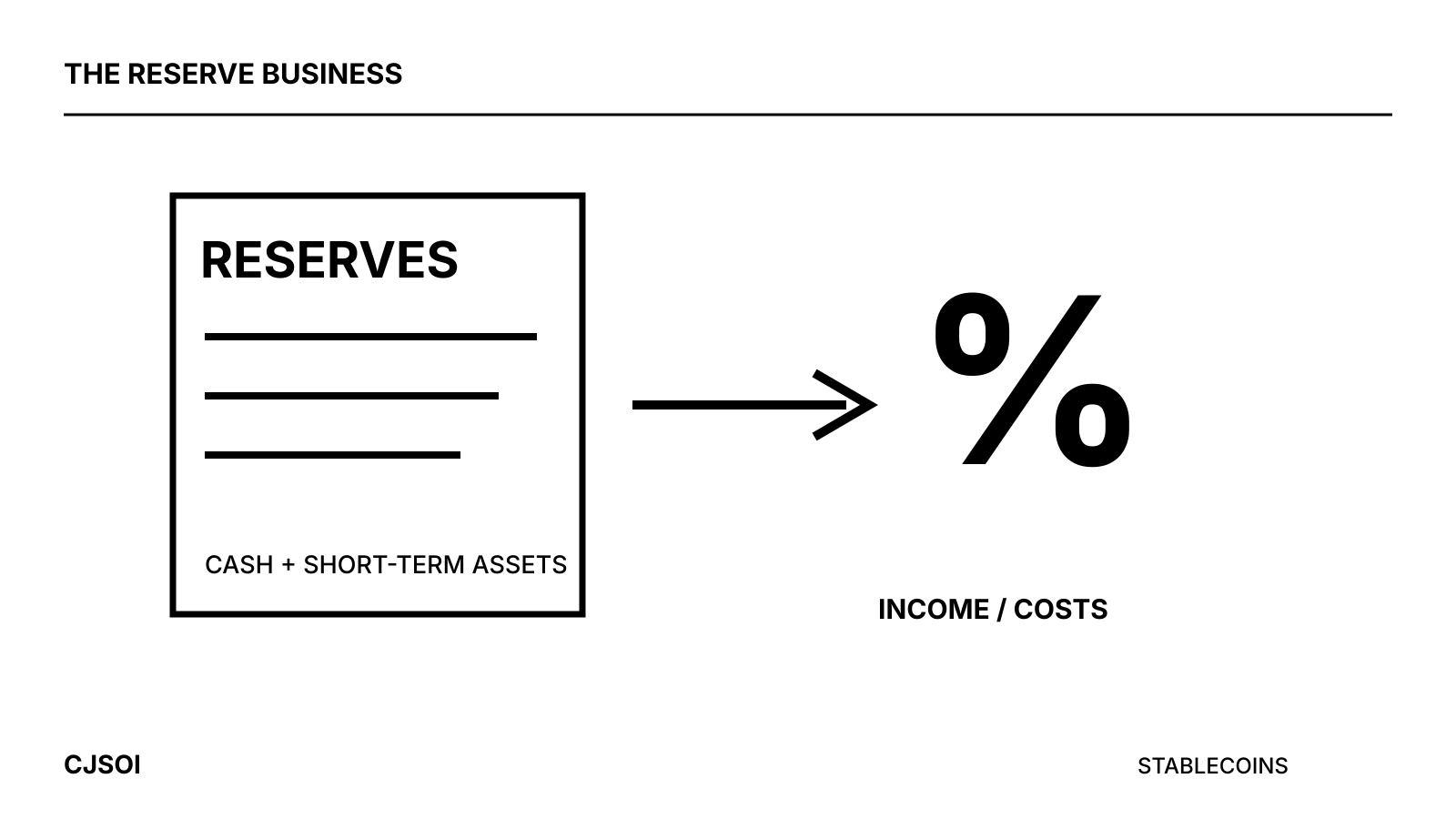
Reserve income is a separate flow. Cash deposits, short-term government securities and other permitted reserve instruments can earn interest. Which instruments an issuer uses, and how it holds them, must be checked in that issuer’s disclosures.
Circle says its USDC reserves are held separately from operating funds. Its transparency page identifies bank deposits, short-dated Treasuries and overnight reverse Treasury repurchase agreements; holdings may include assets within the Circle Reserve Fund managed by BlackRock. Those details describe USDC’s arrangements, not a template that automatically applies to every token called a stablecoin. Source: Circle reserve disclosures.
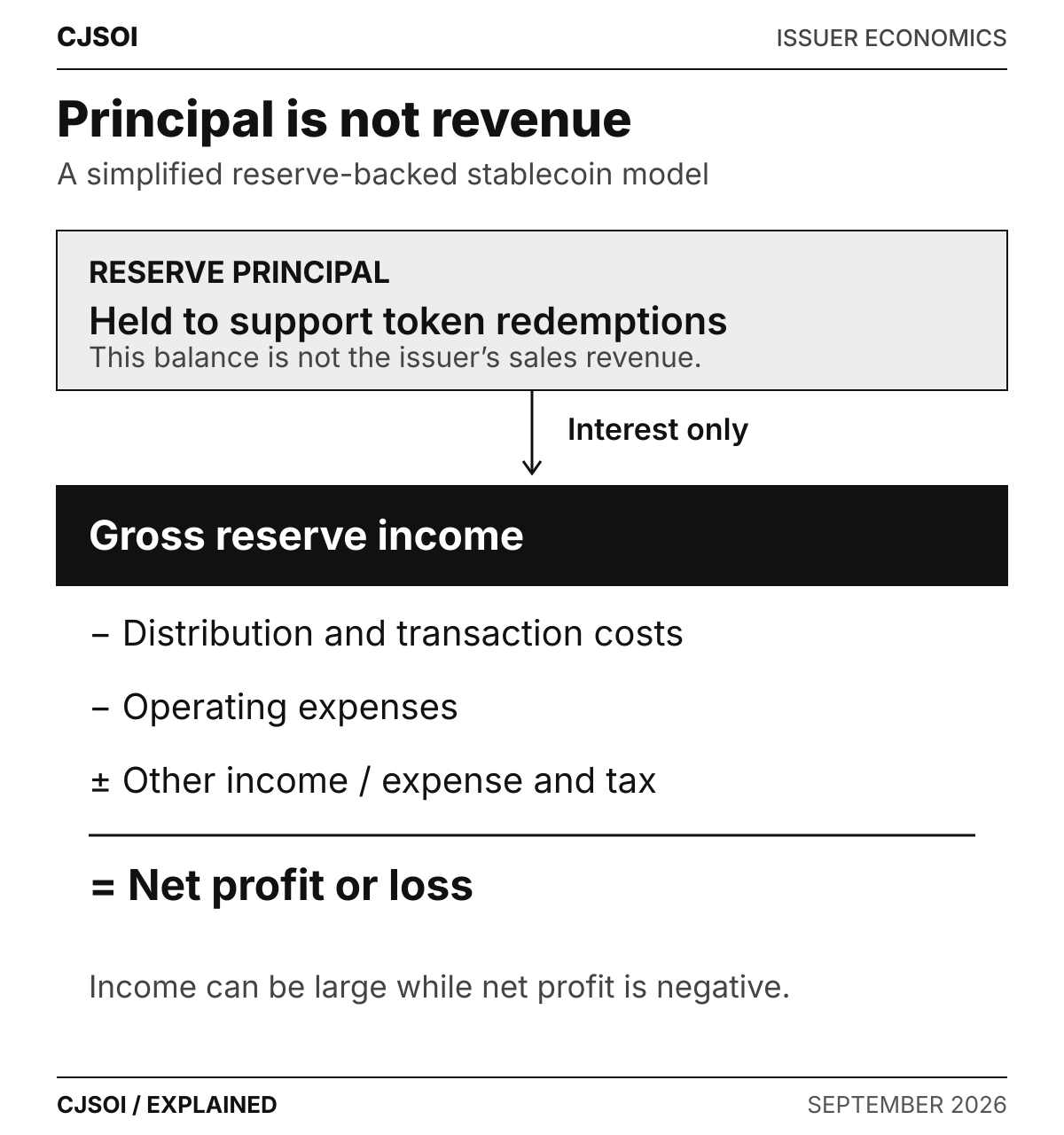
Figure 1. A simplified economic model of a reserve-backed stablecoin issuer. Principal and company income have different purposes. This is a conceptual diagram, not a statement of any issuer’s legal ownership structure. Select the image to view it full size.
The holder’s next question should therefore be about redemption: who will exchange this token for money, through which account, and under what conditions? Our guide to stablecoin redemption follows that process. Interest earned on reserves does not, by itself, give a token holder a right to receive that interest.
The basic revenue equation
A first approximation is:
Annual reserve income ≈ average interest-earning reserves × average annual yield.
The word “average” matters twice. If a stablecoin doubles its supply in December, applying its year-end balance to the entire year’s interest rate will overstate the income it could have earned. Likewise, a rate quoted on the last day of the year may say little about the rates available in the preceding eleven months.
Here is a deliberately simplified calculation. Assume $1 billion of interest-earning reserves stays constant throughout the year. At a 4% annual yield, gross interest would be $40 million. At 3%, it would be $30 million. These are educational assumptions, not forecasts or quoted returns from an issuer.
A one-percentage-point decline in yield reduces annual gross income by $10 million on that unchanged $1 billion balance. To earn the original $40 million at 3%, the model needs average interest-earning reserves of about $1.333 billion, an increase of one-third.
Real portfolios are more complicated. Cash balances may earn different rates from securities, instruments mature at different times, and an issuer may have other revenue. The calculation is useful because it isolates the sensitivity: lower rates must be offset by larger balances, better economics elsewhere, or lower costs if earnings are to be maintained.
For a reader evaluating results, growth in circulating tokens and growth in interest income belong next to each other. Neither number makes much sense in isolation.
Circle’s results: follow the money after revenue
Circle’s annual results show how large the gap between revenue and profit can be. The table below uses the consolidated statement figures, expressed in millions of dollars and rounded to one decimal place.
| Financial measure | FY2024 | FY2025 |
|---|---|---|
| Reserve income | $1,661.1m | $2,636.8m |
| Other revenue | $15.2m | $109.8m |
| Total revenue and reserve income | $1,676.3m | $2,746.6m |
| Distribution, transaction and other costs | $1,017.4m | $1,663.7m |
| Revenue remaining after those costs | $658.9m | $1,083.0m |
| Operating expenses | $491.7m | $1,179.4m |
| Operating income / (loss) | $167.2m | ($96.4m) |
| Net income / (loss), continuing operations | $157.0m | ($69.5m) |
Source: Circle’s FY2025 results and comparative FY2024 financial statements. “Revenue remaining” is calculated by subtracting the listed costs from total revenue and reserve income. Net income also reflects other income or expense and tax; it cannot be obtained by stopping at operating income.
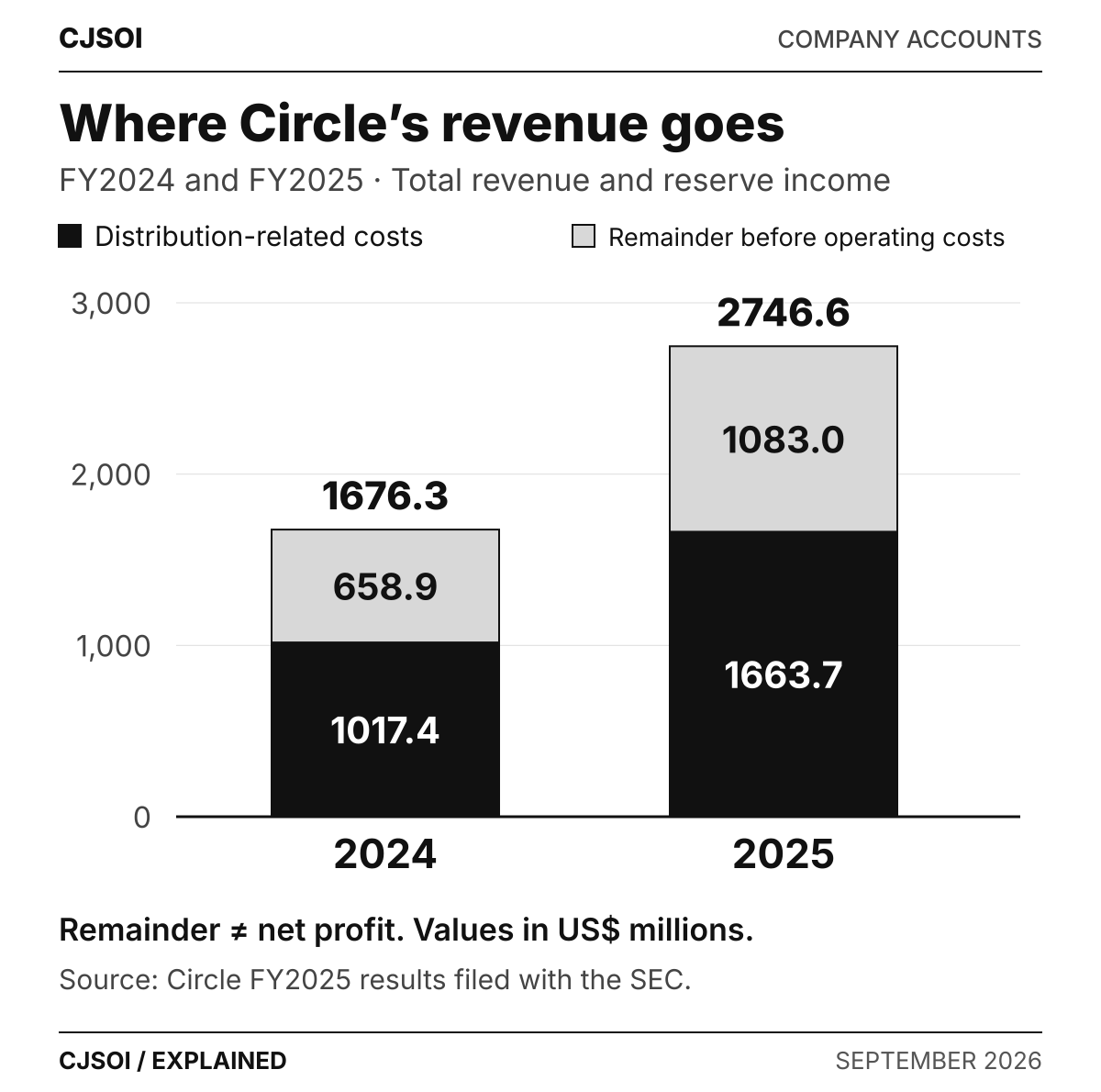
Figure 2. Circle’s revenue grew, but a substantial share went to distribution, transaction and other costs. The light segment is the remainder before operating expenses, other income or expense, and tax. It is not net profit. Data: the SEC-filed results above; rounded labels in US$ millions. Select the chart for full size.
Reserve income represented approximately 96% of Circle’s total revenue and reserve income in 2025. Distribution, transaction and other costs consumed approximately 61% of that total. These percentages are calculations from the financial statements, not separate company guidance.
The scale of distribution costs is particularly revealing. A stablecoin issuer needs its token to be useful and available. Exchanges, wallets and commercial partners can help it reach customers and retain balances; the economic arrangements supporting that distribution can be expensive.
It would be a mistake to assume that every dollar of a larger reserve base drops through to shareholders. The contracts connecting an issuer to its distribution network matter almost as much as the interest rate.
Why a growing issuer can report a loss
The next expense layer helps explain Circle’s 2025 loss. Operating expenses rose to about $1.179 billion, exceeding the approximately $1.083 billion remaining after distribution, transaction and other costs.
Circle said the year was materially affected by $424 million of stock-based compensation triggered by its initial public offering. That makes 2025 a poor year to treat as a simple “normal” cost ratio. It also illustrates why the financial statements and the explanation of unusual expenses need to be read together. Source: Circle’s full-year earnings release.
An expense can affect accounting profit without representing an equivalent cash payment in the same period. Conversely, excluding it from an adjusted measure does not make it irrelevant to shareholders. Stock-based compensation, for example, is part of the economic cost of paying employees and can affect ownership dilution.
Circle also reported $582 million of adjusted EBITDA for 2025. That is a company-defined, non-GAAP performance measure with exclusions; it is not interchangeable with the reported net loss. A useful article or investor presentation should name the measure being discussed, rather than switching between “earnings,” “profit” and “cash generation” as though they mean the same thing.
There is no contradiction in a business having a large revenue base, positive adjusted EBITDA and a net loss in the same year. The reconciliation explains the differences.
Supply, payment volume and fees measure different things
Imagine a fixed pool of one million tokens passing through a series of wallets. If the same tokens are transferred repeatedly, payment volume can grow while the amount of money supporting the tokens remains unchanged.
An issuer whose main income comes from reserves benefits from the average balance outstanding, not automatically from each movement of that balance. A payment provider, exchange or blockchain validator may earn fees elsewhere in the journey, but those fees should not be casually attributed to the token issuer.
The distinction becomes important when reading statements about trillions of dollars in onchain activity. Volume may describe adoption or network usage. It does not provide an issuer’s revenue unless the relevant fee model and chargeable activity are also known.
The reverse is possible too: customers can hold a large stock of tokens with relatively little turnover, leaving a substantial reserve base. That could generate interest while telling us little about everyday payments. See how to read stablecoin supply for the difference between outstanding balances and activity.
Other revenue deserves its own analysis. In Circle’s 2025 results it rose to $109.8 million from $15.2 million. That growth mattered, but the reserve-income line still dominated. Extrapolating a diversified future business from a small, fast-growing line would require more evidence about its customers, costs and durability.
What happens when rates fall or holders redeem?
A reserve-income model faces two separate pressures: the yield can decline and the balance earning that yield can shrink. They can occur together.
Suppose the educational $1 billion reserve pool falls to an average $800 million while its annual yield declines from 4% to 3%. Gross interest falls from $40 million to $24 million, a 40% decline. This combines a smaller base with a lower rate; it is not a prediction about USDC or any other asset.
Costs need not fall proportionally. Some commercial arrangements may vary with balances or revenue, while staffing, technology and other commitments can adjust more slowly. The actual contract terms and disclosures determine the result.
Redemptions raise an additional operational question: how quickly can assets and bank balances be made available to meet eligible customers’ withdrawals? An income statement cannot answer that on its own. Readers need reserve composition and redemption information as well as company financial results.
Circle publishes weekly reserve information and monthly third-party assurance reports. The scope and date of those reports matter: a reserve assurance report and an annual company financial statement answer different questions. Neither should be presented as a guarantee that every possible operational or market problem has been eliminated. Source: Circle transparency reporting.
A practical way to read an issuer’s next report
Read the figures in an order that exposes the business model. Start with average circulating balances and reserve composition. Then inspect the yield earned and the resulting reserve income. This separates growth driven by new balances from growth driven by the rate environment.
Next, deduct distribution and transaction costs before thinking about margins. Read the explanations for changes in those costs, especially one-off arrangements or changes in how balances are distributed.
Finally, look at operating expenses, reported net income and any adjusted measure reconciliation. If a headline relies on an adjusted result, find the excluded items. If it relies on a reserve attestation, do not treat that as evidence about corporate profitability.
For token holders, this financial analysis is only one part of the evaluation. Direct redemption access, service availability and the exact asset being held still matter. For shareholders, the central question is how much income survives the cost of attracting and serving those balances.
Questions readers ask
Does holding a stablecoin automatically earn the reserve yield?
No. A token’s backing assets may generate income without paying that income to holders. An exchange rewards program, lending position or yield-bearing product introduces separate terms and potentially separate risks. Our DeFi yield guide explains why those returns need their own analysis.
Does a profitable issuer guarantee a stable token price?
No. Corporate profitability does not replace the need to examine reserves, redemption access, liquidity and operational arrangements. A company’s income statement and a token’s secondary-market price describe different parts of the system.
Can the Circle case be applied to every stablecoin issuer?
The questions can; the margins cannot. Issuers can differ in reserve assets, distribution contracts, revenue sources, costs and reporting scope. Use this case as a method for reading disclosed figures, not as an estimate of another company’s undisclosed earnings.
Data note: this article was expanded on September 26, 2026. The financial case covers FY2024 and FY2025. Illustrative calculations assume constant annual balances and yields, exclude costs unless stated, and are not investment recommendations.