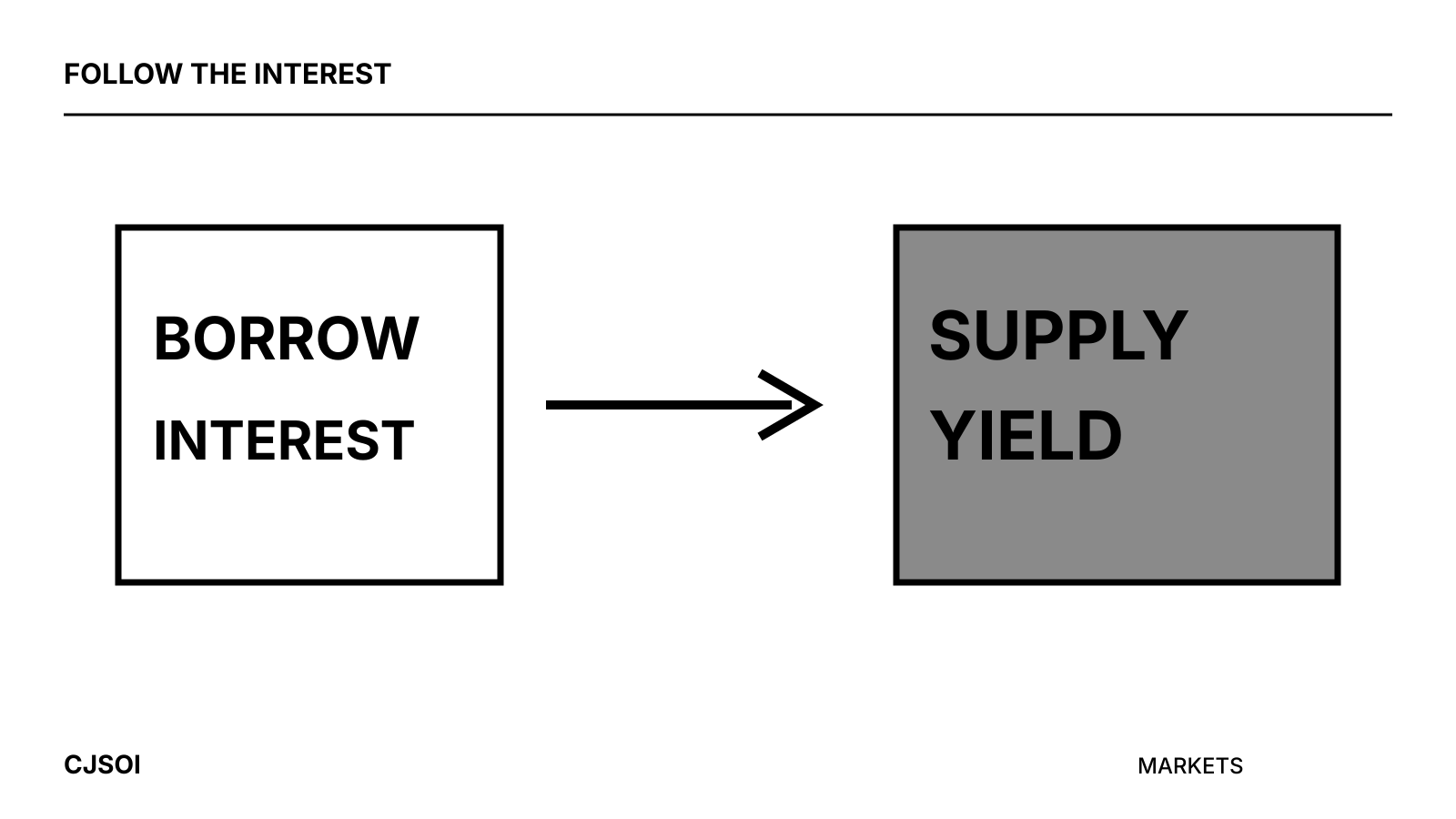
In a pooled DeFi lending protocol, borrowers can pay interest that funds returns to suppliers. The rate is part of the protocol’s economic design, not money created merely because a token sits in a wallet.
Additional rewards may come from incentives or other arrangements. To understand a quoted yield, separate those components before comparing it with another product.
Follow the borrower payment
Aave’s v3 documentation describes suppliers providing assets to liquidity pools and receiving interest-bearing aTokens. Supplier yield comes from borrower interest after the reserve factor.
The reserve factor is the portion retained according to the protocol’s configuration rather than passed through to suppliers. The relationship means a supplier’s rate need not equal the rate paid by a borrower.
A token balance growing in an interface is therefore only the visible result. The useful economic question is who pays for that growth and under what conditions.
Utilization changes the rate
Utilization describes how much of the supplied liquidity is being borrowed. Aave v3 uses an interest-rate model with two slopes and an optimal utilization point. Borrowing becomes more expensive more quickly above that point.
This creates a mechanism for rates to respond to demand and available liquidity. It does not guarantee that supply and demand will always rebalance smoothly.
A current annualized rate is a snapshot expressed on an annual basis. If the underlying rate changes tomorrow, the eventual return over a year will not equal a simple projection from today’s display.
Lending liquidity is not an unlimited withdrawal promise
Aave states that withdrawals depend on available unborrowed liquidity and on the collateralization of a user’s active borrowing positions. If much of a pool’s assets is borrowed, the amount immediately available for withdrawal can be constrained.
That distinction is easy to miss when comparing interfaces. A visible balance and an immediately withdrawable amount are not necessarily the same.
The assets themselves also matter. A stablecoin’s target price does not remove issuer or redemption risk, and a lending protocol adds smart-contract, market and liquidity dependencies.
Collateral protects the pool through a mechanism
Aave borrowers supply collateral and are monitored through a health factor. Under its v3 rules, a position becomes eligible for liquidation when that factor falls below one. Liquidators repay part of the debt and receive collateral at a defined discount.
The mechanism is intended to manage undercollateralized positions. It should not be described as eliminating every possibility of loss. Asset prices, oracle inputs, execution and protocol parameters all matter to the outcome.
Separate base interest from incentives
An interface may display borrower-funded interest alongside additional rewards. Those rewards can have different funding sources, durations and market values.
Ask whether the displayed figure is variable, whether it assumes compounding and whether it includes a reward token whose price can change. A precise-looking percentage can conceal several assumptions.
For a different yield-bearing structure, read tokenized Treasury funds. The income source and the holder’s claim are not interchangeable.
Questions
Is a lending APY fixed for a year?
Not unless the specific product explicitly fixes it. Variable lending rates can change as conditions change.
Can I always withdraw the entire displayed balance immediately?
Not necessarily. Available pool liquidity and collateral requirements can constrain withdrawals.
Does overcollateralization make lending risk-free?
No. It is a risk-management mechanism within a system that still has technical, market and liquidity risks.
Sources
Aave v3 overview: supply, rates, withdrawals and liquidations.