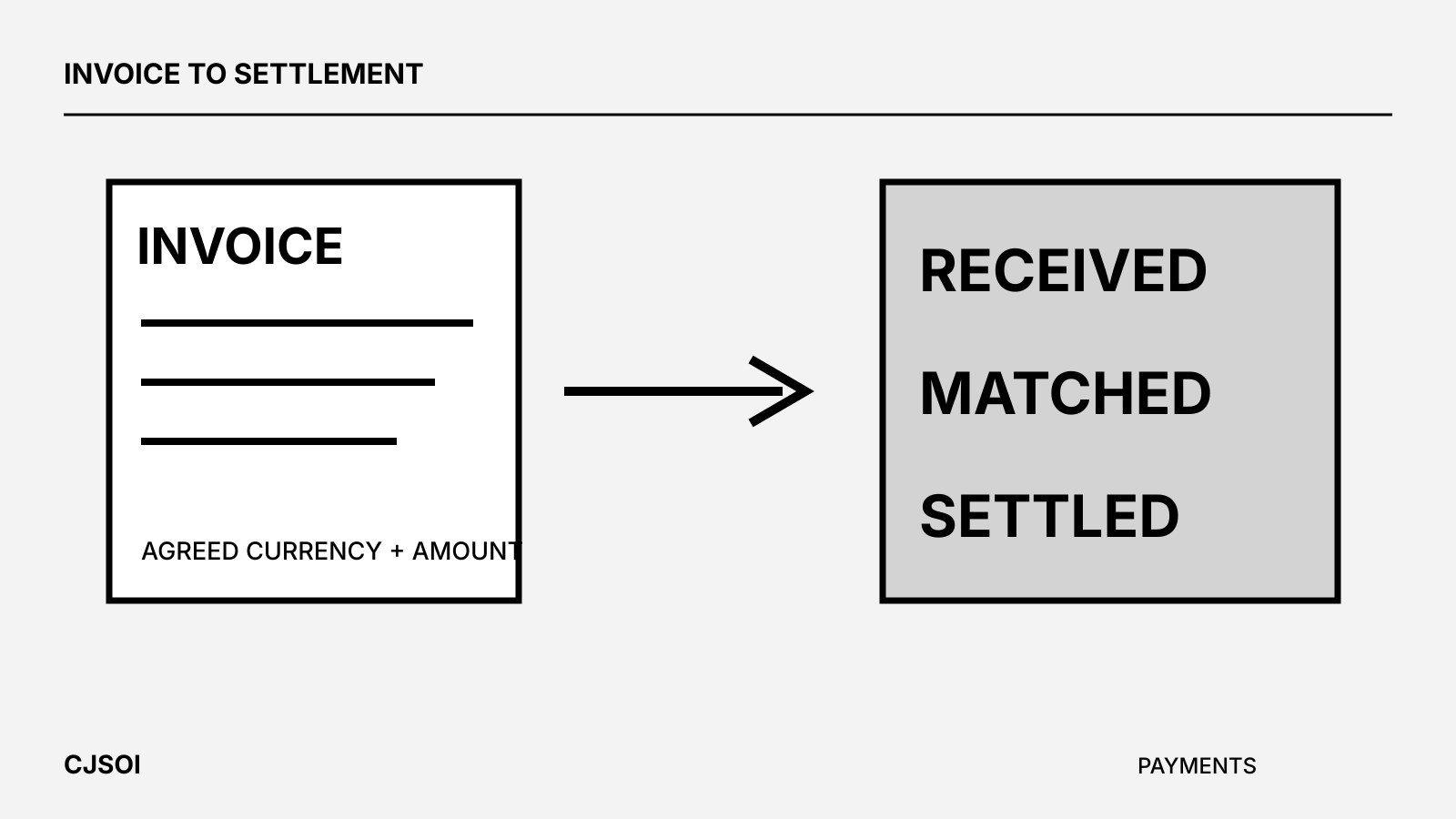
Paying a supplier in stablecoins begins with an agreement about what settles the invoice. The parties need to know the asset, network, amount and point at which the payment counts as received. A transaction hash alone cannot resolve an ambiguous agreement.
This explainer follows a simplified business payment. It does not replace a company’s treasury, accounting or jurisdiction-specific requirements.
Agree on what the supplier will receive
An invoice denominated in dollars and an invoice payable in a specific dollar stablecoin are not automatically the same arrangement. The supplier may accept tokens directly, use a provider that converts them or require fiat credited to a bank account.
Visa’s B2B overview describes combinations of fiat funding, stablecoin funding and different payout endpoints. The useful lesson is that the final recipient experience depends on the whole route.
For an illustrative $10,000 invoice, the agreement should make clear whether the supplier must receive 10,000 units of a named token or $10,000 after conversion. It should also identify who bears fees and any price difference during conversion.
Identify the exact destination
A wallet address is not a complete payment instruction. The network and token contract matter, as do any destination tags or other references required by the receiving service.
Instructions should be verified through a trusted channel, especially when a supplier changes them. This is a general payment-control principle, not a claim that blockchains provide a built-in way to reverse an incorrect business payment.
A familiar ticker can conceal an asset mismatch. Circle distinguishes native USDC from bridged versions, which rely on different issuance arrangements. The receiving provider must support the exact asset sent.
Separate confirmation from reconciliation
The network record can show a transfer’s sender, destination, asset and amount. The accounting record connects that movement to a particular invoice and counterparty.
Those records answer different questions. A confirmed transfer does not itself prove that it paid the right invoice, and an invoice marked paid does not independently prove the funds reached the intended destination.
Useful reconciliation connects the invoice reference, payment instructions, transaction identifier, fees and resulting balance. If a provider converts the tokens, its conversion and payout records form part of the trail.
Check the final leg
If the supplier wants bank money, the process is not finished at the wallet. Conversion, redemption and a bank payout may follow. Circle Mint is one example of infrastructure connecting institutional token balances with bank funding and redemption.
An around-the-clock network can reduce dependence on banking hours for the token transfer. It does not guarantee that every provider or payout endpoint operates without cut-offs.
Read the full-cost guide before comparing this route with a conventional transfer. The relevant result is a paid and reconciled invoice, not simply a low-cost network transaction.
Questions
Does a transaction hash prove an invoice is settled?
It proves a network transaction can be looked up. Settlement of the invoice also depends on the agreement and reconciliation.
Who should bear conversion fees?
That should be agreed between the parties. The technology does not decide it.
Can the supplier receive fiat while the sender pays in tokens?
A provider may offer that route, subject to its supported currencies, markets and terms.
Sources
Visa’s B2B stablecoin overview; Circle Mint; Circle on bridged USDC.