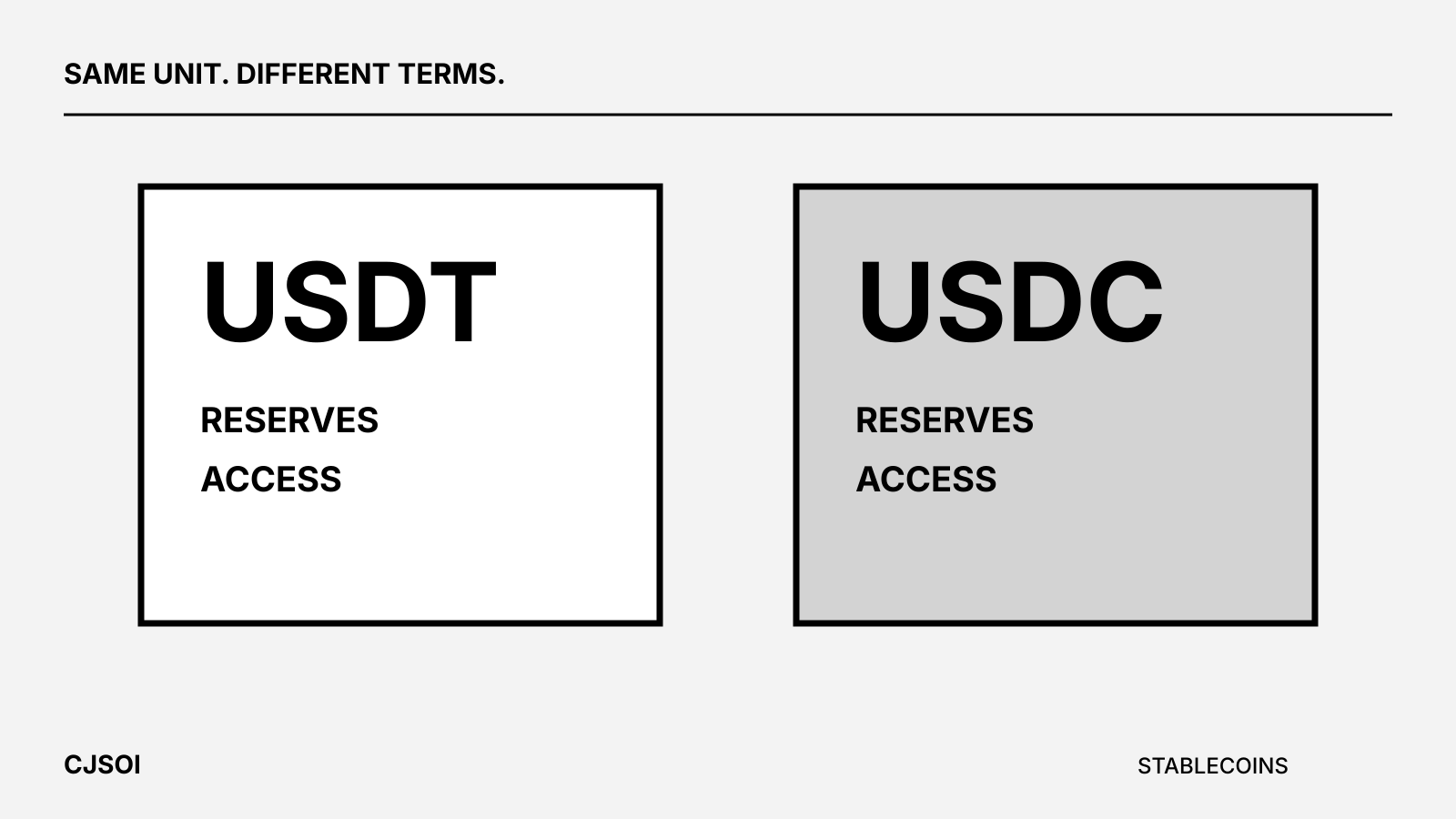
USDT and USDC both target the U.S. dollar, but their shared unit of account does not make their reserve disclosures, redemption arrangements or supported networks identical. A useful comparison begins with the issuer relationship and ends with the route you will use to move the money.
This is a framework for reading those differences, not a recommendation to buy either token. Product terms below were checked on September 26, 2026.
Read the reserve report’s perimeter
A reserve disclosure should identify the issuing entity, the liabilities being measured, the assets supporting them and the date of the measurement. Comparing an issuer’s circulating tokens with an unrelated group’s consolidated assets does not answer whether those particular tokens are backed.
Circle’s transparency page describes USDC reserve assets including bank cash and short-duration U.S. Treasury exposure, with assets held separately from operating funds. It publishes reserve and minting information and links to monthly third-party assurance reports.
Tether’s disclosure distinguishes circulating tokens from authorized tokens not yet issued. It also specifies the entity and reporting scope for its reserve information. Inventory prepared for issuance should not automatically be counted as tokens already in users’ hands.
These disclosures should be read at matching dates where possible. A current circulation total and an older reserve report answer different questions. Headline labels such as “cash equivalents” are also less informative than the categories and notes underneath them.
Redemption access is a separate comparison
Circle describes Circle Mint as infrastructure for institutional users such as exchanges, banks and payment applications. That is not the same product as a consumer exchanging a small balance inside a trading app.
Tether’s published fees specify a $100,000 minimum acquisition or redemption request and a redemption charge equal to the greater of $1,000 or 0.1%. Account verification and approval apply. These conditions concern direct issuer access; they do not impose a $100,000 minimum on every secondary-market USDT trade.
A platform offering both tokens may provide very different deposit, conversion and withdrawal routes. Read those platform terms as well as the issuer terms. Our redemption explainer separates the steps.
Check the actual asset you will receive
The name in a wallet is not the complete asset identifier. A network and token contract are part of the answer. There may also be a distinction between native issuance and a representation backed by tokens locked through a bridge.
For example, Circle explains that bridged USDC is created through a third-party arrangement, while native USDC is issued by Circle. This adds an infrastructure question that a simple USDT-versus-USDC comparison can miss.
Confirm that the receiving service supports the exact token on the exact network. A network available for deposits may not be available for withdrawals, and an issuer can change the chains it supports.
A comparison that matches the task
For a supplier payment, ask what the supplier accepts and how it will convert the proceeds. For treasury holdings, examine reserve reporting, custody and the available redemption relationship. For moving between trading venues, check network compatibility, liquidity and total conversion cost.
There is no single number that combines these into a universal winner. A low network fee does not establish strong redemption access, just as a detailed reserve report does not ensure that a particular exchange will process a withdrawal immediately.
Questions
Does “one dollar” mean the tokens are interchangeable everywhere?
No. Platforms support specific assets and networks, and conversion between them may involve a trade or a fee.
Is authorized token inventory the same as circulating supply?
Not necessarily. Tether explicitly separates authorized-but-not-issued balances in its disclosures.
Should reserve reports be compared without their dates?
No. The measurement date, reporting entity and covered liabilities are essential to understanding the comparison.
Sources
Circle transparency; Circle Mint; Tether transparency; Tether fees; Circle on bridged USDC.